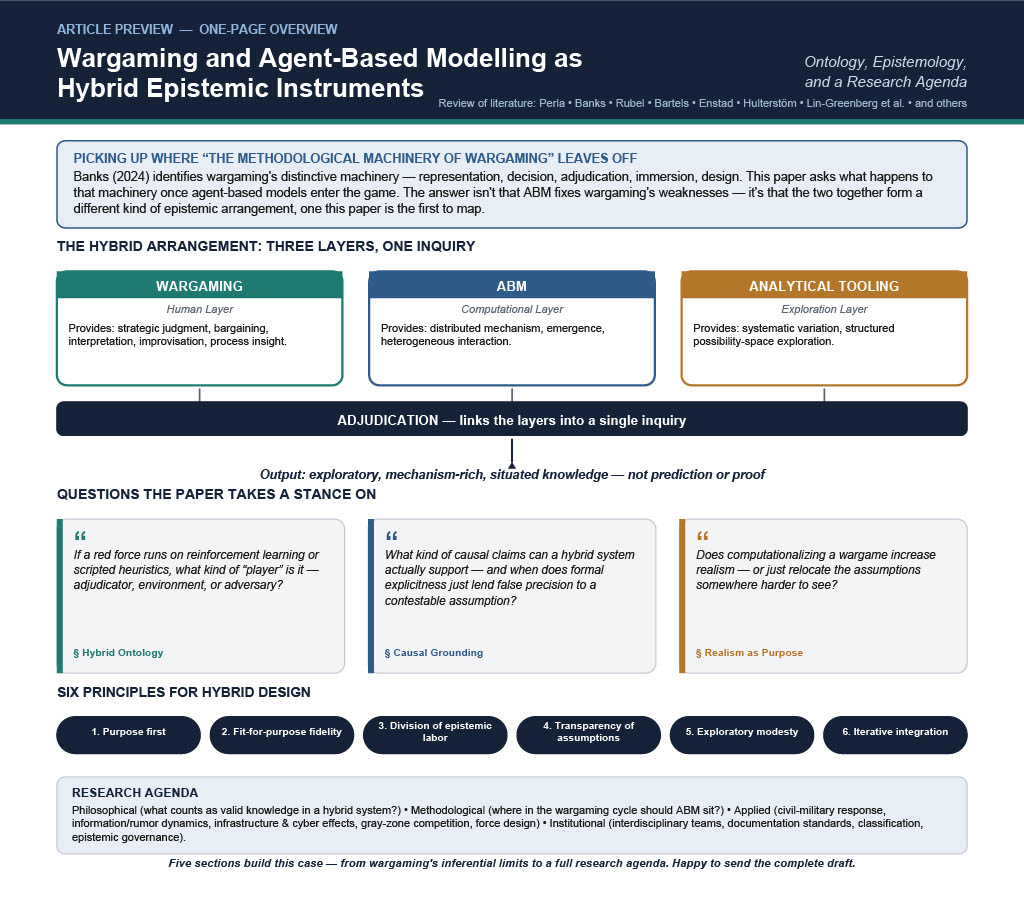
Note: The above picture has been generated with Claude to have a visual overview of the full paper. All text in this post and the paper itself are human-written.
Research Extension · Wargaming · Agent-Based Modelling · Human–Machine Systems
Long-form research article · approx. 8,400 words
Abstract
Wargaming and computational simulation are increasingly being combined in military, policy, and research environments, yet their integration is often discussed primarily as a technical problem. This paper argues that combining wargaming with Agent-Based Modelling creates something more consequential: a hybrid epistemic arrangement in which human players, computational agents, adjudication systems, and analytical tools perform different forms of epistemic work.
The paper first reconstructs the ontology and epistemology of wargaming, emphasizing its strengths in eliciting strategic judgment, deliberation, interaction, and decision-making under uncertainty, while identifying limitations including adjudicative opacity, weak mechanism specification, restricted systematic variation, and difficulties representing distributed background dynamics. It then examines ABM as a generative and exploratory method capable of formalizing heterogeneous interaction, emergence, and repeated exploration, while introducing its own challenges of abstraction, validity, representation, and interpretation.
Rather than presenting ABM as a replacement for human-played wargaming, the paper proposes an integrated framework in which each method is assigned tasks suited to its epistemic strengths. It concludes by developing a research agenda for the philosophical, methodological, applied, and institutional design of hybrid human-computational wargaming systems.
The paper itself explicitly frames this contribution as a shift from the question of whether ABM can “improve” wargaming to the question of what kind of knowledge the combination can produce and how the epistemic work is distributed among the components.
Key Argument
The important question is not whether computation can be added to a wargame. It is which forms of judgment, representation, mechanism, and inference should be assigned to humans, models, adjudicators, and analytical systems.
Why Hybridise?
Wargaming Contributes
- Situated human judgment
- Strategic interaction
- Interpretation and improvisation
- Bargaining and role conflict
- Deliberative and process insight.
ABM Contributes
- Explicit mechanisms
- Heterogeneous interaction
- Distributed background dynamics
- Emergence and nonlinear effects
- Eepeatability and sensitivity analysis
- Systematic exploration of assumptions.
The methods therefore have different comparative advantages. Wargaming is especially useful for exploring what strategic actors do when they confront one another under uncertainty and consequence. ABM is especially useful for examining the macro-patterns that may emerge from many interacting actors operating under specified rules and conditions.
What The Paper Does
01 — Reconstructs Wargaming
Examines what kind of object a wargame is and what kinds of knowledge it can legitimately produce.
02 — Identifies Its Inferential Limits
Focuses on adjudication, mechanism specification, systematic variation, participant dependence, background dynamics, and institutional assumptions.
03 — Reconstructs ABM
Treats Agent-Based Modelling as a generative and exploratory instrument rather than a forecasting machine.
04 — Proposes a Hybrid Framework
Explains how different epistemic tasks can be allocated across human players, computational agents, adjudication, and analysis.
05 — Builds a Research Agenda
Identifies philosophical, methodological, applied, and institutional questions that need to be answered before hybrid systems can be treated as defensible analytical instruments.
Practical Implication
Hybrid design should begin with the substantive problem rather than the available technology. Strategic bargaining, role conflict, interpretation, and improvisation may be better represented through human players, while information diffusion, civilian response, infrastructure cascades, or other distributed dynamics may sometimes be better represented computationally.
The task is therefore not to automate as much of the wargame as possible. It is to decide deliberately where human judgment adds value, where formal modelling adds value, and how conclusions should be drawn from the combined system.
Why I Am Returning to This
This paper sits directly at the intersection of several strands of my current research. It connects wargaming and Agent-Based Modelling to the wider problem of human-machine strategic analysis, while also raising the philosophical question that underlies much of my work: what can computational models actually tell us, and under what conditions should their outputs affect strategic judgment?
I therefore see the paper not as a finished endpoint, but as the starting point for further work on hybrid simulation environments, computational adjudication, expert-model interaction, validation, and the deliberate allocation of analytical tasks between humans and machines.
Related Research Directions
01 — Wargaming, AI & Simulation
Primary substantive research direction.
04 — Human-Machine Collaboration
The paper is fundamentally concerned with the distribution of analytical and epistemic work between humans and computational systems.
06 — NetLogo & Agent-Based Modelling for International Relations
Provides the broader ABM connection and a route toward developing concrete models.
07 — Philosophy of Computational Social Science
Directly concerned with ontology, epistemology, explanation, validation, and inference.
Read the Original Paper
The paper below presents the full argument and research agenda. It is retained as a long-form research document and may form the basis of later, more focused pieces.