Early-stage research directions exploring how computational methods, human judgment, and strategic analysis can be combined to study international politics. These are research directions I am currently exploring rather than fixed or fully developed research programmes.
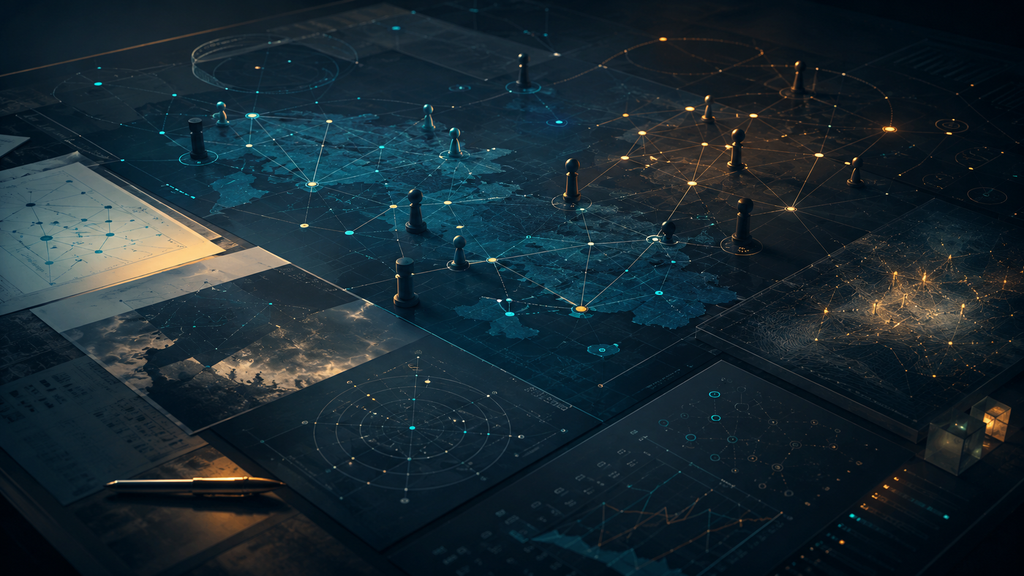
These directions are work in progress. Some may develop into research projects, others into essays, methodological frameworks, or longer-term research programmes
Select a direction to explore the underlying question and current thinking
01 – Wargaming, AI & Simulation
Human–Machine · Simulation · Strategy · Decision-Making
What happens to the value of a wargame when part of the reasoning and adjudication becomes computational?
Explore this Research Direction
Wargaming is a structured exercise where people play out a scenario (e.g. a crisis, conflict, or negotiation) and make decisions under the same kind of uncertainty real decision-makers face. What makes a wargame useful is the record of how people actually reason under pressure: what they assumed, what surprised them, and where their reading of the situation turned out to be wrong.
That output has always depended on human judgment at every stage: designers deciding what is fixed and what remains open, adjudicators interpreting what a move achieves, and players bringing their own reading of the scenario to the table.
Simulation and AI tools are increasingly becoming part of that process, and my research works on three levels at once.
Academically, it examines how simulation methods, particularly Agent-Based Modelling, and human judgment are converging inside modern wargaming, and what that convergence means for the epistemology of the method: what makes a wargame’s findings credible once part of the adjudication is no longer human?
Practically, it aims to produce usable guidance for practitioners on where these tools genuinely extend what a wargame can reveal, and where they risk replacing the interpretive work that made wargaming valuable in the first place.
More broadly, the project is meant to remain readable to people who are specialists in neither wargaming nor AI. It therefore provides one concrete, bounded way into the larger question of human-machine collaboration.
02 – Network Analysis & International Relations
Networks · Geo-economics · International Order · Computational Methods
Can the structure of international relationships explain power and order in ways that conventional measures cannot?
Explore this Research Direction
Network analysis studies systems by mapping the relationships between the actors within them rather than treating every actor in isolation.
In international relations, this means representing states, institutions, or other actors as nodes connected by relationships such as trade, alliances, diplomatic contact, or shared institutional membership, and asking what the structure of that system can tell us.
Important concepts include an actor’s position within the network, the structure of the network as a whole, and competing explanations for why particular ties form.
The aim is not simply to apply network analysis to one particular empirical case. I am interested in developing theoretical arguments about international politics through network analysis.
The substantive centre of this direction is geo-economics and questions of regional and global order: whether power and influence may sometimes be explained better by a state’s or region’s position within networks of trade and dependency than by conventional capability measures, and whether regional order may be explained better by the real density and pattern of relationships among regional actors than by the formal institutions that are supposed to hold that region together on paper.
The goal is ultimately to develop theoretical claims about how the international system is structured that become visible when relationships, rather than isolated actors, are placed at the centre of the analysis.
03 – AI & Intelligence Analysis
AI · Intelligence · OSINT · Forecasting · Human–Machine
How can computational tools extend intelligence analysis without simply introducing new forms of analytic error?
Explore this Research Direction
“AI” covers at least two quite different types of tools relevant to intelligence work.
Large Language Models are particularly useful for synthesis: reading through large volumes of material and identifying or summarising what is relevant. This matters for Open-Source Intelligence, where analysts may face far more raw information than they could realistically read themselves.
Forecasting systems perform a different task: producing calibrated probability judgments about whether an event is likely to occur, connecting them more closely to the tradition of structured forecasting.
This research direction works on the practical and academic sides simultaneously.
Methodologically, I am building on literature from intelligence studies (including intelligence tradecraft, warning, analytic bias, and the validation of assessments) and reading it alongside computational social science research addressing similar underlying questions.
The aim is not to assume that the two fields agree, or that methods from one can simply be imported into the other. Instead, I am interested in identifying where the two traditions converge, where they are answering different questions, and where they may be talking past one another.
That comparison can then shape more grounded arguments about where computational systems can genuinely contribute to intelligence analysis.
04 – Human-Machine Collaboration
Human–Machine · AI · Judgment · Trust · Decision Support
What should remain human? What can be delegated? And what happens when neither human nor machine should reason alone?
Explore this Research Direction
Human analysts fail in well-documented ways: groupthink can cause a group to converge on a shared view and stop questioning it. Motivated reasoning encourages people to find evidence supporting what they already believe. Fatigue gradually erodes judgment over long periods of work.
Machines fail differently: an AI system does not become tired or defensive, but it can encode assumptions invisibly through the way it has been designed or trained. And when it is wrong, it may present its conclusions with the same confidence as when it is right.
This is the subject of the full Human-Machine Strategic Analysis series, which explores these problems in depth across fourteen pieces.
It is also the direction that ties much of the rest of this research agenda together.
Wargaming, intelligence analysis, policy-document analysis, simulation, and other computational approaches are all, underneath, specific cases of the same underlying problem:
How should the work of judgment be divided between a human and a computational system? And how does an organisation make that division deliberately rather than discovering it by accident?

05 – LLMs and Policy Analysis
AI · Policy · Text Analysis · Strategic Change
Can computational analysis reveal gradual changes in policy that are difficult to detect by reading documents individually?
Explore this Research Direction
Government and institutional strategy documents — including defence white papers, foreign-policy doctrines, and official statements — change gradually over time.
Often those changes are not formally announced, but instead appear in how documents are written.
Which threats receive more attention than they did previously? Which language becomes harder or softer? Which concepts appear repeatedly? Which issues quietly disappear?
Reading enough years of documents side by side to detect that kind of drift has always been possible in principle, but rarely gets done systematically by hand because the process is slow.
This research direction remains method-first, meaning that no specific document set is locked in yet. That is deliberate.
The more difficult question comes first: what should count as a meaningful shift in a document’s position, priorities, or framing, rather than the ordinary variation one would expect between documents written by different authors at different moments?
Developing a defensible answer to that methodological question is currently the priority.
06 – NetLogo and Agent-Based Modelling for International Relations
Simulation · ABM · Emergence · International Relations
What can simple interacting agents teach us about complex political outcomes?
Explore this Research Direction
Agent-Based Modelling simulates collections of individual “agents” following rules, interacting with one another, and producing larger patterns that were not explicitly programmed into the model.
NetLogo is a programming environment designed specifically for Agent-Based Modelling. It is widely used for teaching and prototyping because it is relatively accessible without a heavy programming background, while still supporting serious modelling work.
ABM is particularly suited to questions in international relations because many political and strategic outcomes emerge from many actors making local decisions rather than from a single central plan.
Examples include protest movements, escalation dynamics, alliance formation, strategic competition, diffusion, and collective behaviour.
At present, this research direction is partly a record of learning progress: notes, experiments, and examples developed alongside the modelling skills themselves. It is not intended to present itself as a finished handbook written from a position of expertise.
The direction in which it is developing is a two-way bridge.
On one side: showing the NetLogo and ABM modelling community what international relations can offer as a source of substantive and theoretically interesting problems.
On the other: showing IR researchers what NetLogo and Agent-Based Modelling can offer as genuinely usable analytical tools.
07 – Philosophy of Computational Social Science
Epistemology · Explanation · Simulation · Computational Methods
What does it actually mean for a computational model to explain something about the real world?
Explore this Research Direction
Before asking what any particular model shows, there is a more basic question:
What does it mean for a pattern produced by a simulation to explain something about the real world?
This question brings older philosophical distinctions into contact with newer computational methods.
It includes questions about the relationship between general rules and specific predictions, the movement from observations toward broader patterns, and what is sometimes called “generative” social science.
The generative approach asks whether an explanation can be demonstrated by showing that a relatively simple set of mechanisms, when run forward, actually produces the pattern being explained rather than assuming an explanation first and fitting observations to it afterward.
This research direction forms part of the foundation underneath the research philosophy presented on the Research Profile page.
It also appears implicitly in much of my other work, whether or not it is named directly.
The plan is to develop this direction in two forms: longer foundational essays that establish the position more systematically, and shorter think pieces that can be revisited and updated as the underlying thinking develops.
08 – The Methodological Triangle for Decision-Making
ABM · Networks · Game Theory · Strategy · Decision-Making
Game theory models strategic choice. Network analysis models relational structure. Agent-Based Modelling allows both to unfold through time.
Explore this Research Direction
Three methods commonly used to study strategic behaviour each capture something the others tend to miss.
Game theory formalises strategic interaction. It asks what an actor should do given its objectives and what it expects other actors to do. Its strength is analytical clarity, but it often requires simplifying situations to relatively small numbers of actors and clearly specified choices.
Social Network Analysis captures relational structure: who is connected to whom, where actors sit within a broader system, and how those positions shape influence, constraints, and opportunities. On its own, however, it says less about how a particular strategic decision is actually made.
Agent-Based Modelling provides one way to connect the two.
A model can contain many actors, each following decision rules that may be informed by game-theoretic logic, interacting through relational structures informed by network analysis, with the researcher observing how those individual decisions and relationships develop over time.
This argument sits near the centre of my research agenda as it applies specifically to strategic studies and decision-making.
It is less a side topic than a potential methodological spine running through several of the other research directions.
At the same time, I want the framework to work independently as an explanatory device: a way for readers to understand how these three methods relate to one another and what each contributes to the study of strategic decision-making.
How the Directions Overlap
These research directions are deliberately overlapping. The same methodological and substantive questions recur across several projects. Rather than separate fields, I see them as different entry points into a connected research agenda.
Human Judgment & Machines
Wargaming · Intelligence Analysis · Human-Machine Collaboration · LLM Policy Analysis
Simulation & Emergence
Wargaming · NetLogo & ABM · Philosophy of Computational Social Science · Methodological Triangle
Networks & Structure
Network Analysis · Methodological Triangle · Geo-economic questions
Strategy & Decision-Making
Wargaming · Intelligence Analysis · Human-Machine Collaboration · Methodological Triangle
Knowledge & Explanation
Intelligence Analysis · Philosophy of Computational Social Science · Human-Machine Collaboration
The common thread across these directions is not a particular technology or method. It is the question of how we can reason more effectively about complex strategic systems when neither human judgment nor computational analysis is sufficient on its own.