Auteur: Gidi Brandes

  • Heuristics and Biases as Agent Rules

    Show people two photographs of unfamiliar political candidates for just a tenth of a second and ask which person looks more competent. Surprisingly, the candidate they choose is more likely to have won the actual election than chance alone would predict. Now ask a second group to take their time and think carefully before making the same judgment. Their predictions are actually worse. Most of their supposedly considered judgments still come from the initial impression, and the additional reasoning contributes little or nothing to predicting the result (Ballew & Todorov, 2007, pp. 17949–17950).

    This finding challenges two common assumptions about human decision-making. The first is that mental shortcuts, or heuristics, are simply poor thinking that can be improved by taking more time. The second is that these shortcuts are generally reliable because they are fast and efficient. Neither is quite right. A heuristic can work remarkably well in one situation and lead to serious mistakes in another.

    Essay 1 introduced an agent that made decisions by searching through a limited set of options. This essay takes the next step. What happens when the information an agent uses to make decisions is itself filtered through a mental shortcut? And how can we represent that shortcut in an agent-based model (ABM) in a way that produces specific, testable behaviour?

    Theory

    Tversky and Kahneman (1974) identified several common shortcuts people use when making judgments under uncertainty. Three are particularly important:

    • Availability: judging how likely something is based on how easily examples come to mind. A recent terrorist attack, for example, may make terrorism seem more likely even if the underlying threat has not increased.
    • Representativeness: judging something based on how closely it resembles a familiar pattern or stereotype. A political candidate who looks and speaks like a typical party member may be assumed to share that party’s positions.
    • Anchoring: relying too heavily on an initial figure or piece of information, even when later evidence suggests it should be adjusted.

    Their central argument was that these shortcuts are often useful, but can also produce predictable and systematic errors.

    Gigerenzer (2008) offers an important qualification. He argues that heuristics work precisely because they ignore some available information. In uncertain environments, trying to process everything can sometimes produce worse decisions than using a simple rule.

    One example is the 1/N rule for investing: divide your money equally across the available investment options. Harry Markowitz, who developed an influential mathematical method for optimising investment portfolios, reportedly used this much simpler approach for his own retirement savings. In tests comparing twelve optimisation strategies across seven real investment problems, none consistently outperformed the equal-allocation rule. The more complex methods were too closely fitted to the historical data and performed poorly when circumstances changed (Gigerenzer, 2008, pp. 22–23).

    The broader point is that collecting and processing more information does not automatically produce better decisions. Sometimes, a simpler rule is more robust.

    Gigerenzer also makes a methodological point that is especially relevant for ABMs. Calling a behaviour “availability bias” or “representativeness” does not yet explain how it works. To model a heuristic, we need to specify what information the agent pays attention to, how that information is processed, and how it affects the agent’s decisions.

    Political Mechanism

    Research on political behaviour shows that heuristics can help people make good decisions with limited information. But it also shows that the same shortcuts can lead them badly astray.

    Ballew and Todorov’s findings about facial judgments were confirmed in a further test before the 2006 US elections. Judgments made two weeks before voting predicted 68.6% of gubernatorial races and 72.4% of Senate races, independently of whether a candidate was already in office (2007, p. 17951).

    Lupia (1994) found a similar pattern in a referendum on insurance reform in California. Voters who knew little about the details of the proposals, but knew which position the insurance industry supported, made almost the same choices as voters who understood the proposals themselves. On Proposition 100, both groups recorded 53% voting yes. Among voters who lacked both kinds of information, only 27% voted yes (p. 71).

    The implication is important for policy analysis: people do not always need a detailed understanding of an issue to make an informed choice. If they recognise a trustworthy and relevant signal, such as who supports a proposal, they may be able to use that signal as a shortcut.

    However, this only works if the signal is reliable.

    Lau and Redlawsk (2001) examined how 657 people used heuristics in a simulated election. Rather than simply asking participants how they decided, the researchers recorded which information they actually looked at.

    Almost everyone relied on shortcuts, but the consequences differed sharply between groups. Among politically knowledgeable participants, extensive use of heuristics increased the probability of making the correct voting choice by around 20 percentage points. Among less knowledgeable participants, it reduced that probability by around 21 percentage points (pp. 962–965).

    Even knowledgeable voters could be misled when familiar signals stopped being reliable. When the researchers introduced a candidate whose positions contradicted the usual stereotypes associated with their political party, the probability of a correct choice among sophisticated users of the party heuristic fell from 0.81 to 0.58 (pp. 964–966).

    The lesson is that a shortcut is only as useful as the conditions in which it is applied. A rule that works in a familiar political environment can become misleading when that environment changes.

    Kuklinski and colleagues (2000) identified another problem: people can be confidently misinformed. In a survey of 1,160 people in Illinois, respondents were asked factual questions about welfare. Among those who substantially overestimated the number of welfare recipients, 74% were very or fairly confident in their answers. Among those who answered correctly, only 47% expressed the same confidence (pp. 798–801).

    This matters because a heuristic does not necessarily correct inaccurate information. If someone starts with the wrong understanding of a situation, a mental shortcut may reinforce that mistake rather than resolve it.

    Nor are these problems limited to ordinary voters. Sheffer and colleagues (2018) tested sitting members of parliament in Belgium, Canada and Israel using decision-making scenarios with financial incentives. Politicians showed many of the same biases as ordinary citizens, including a willingness to take greater risks to avoid losses and a tendency to continue investing in failing projects because resources had already been committed. In one scenario, 83.7% of MPs supported extending a failing loan, compared with 71.1% of citizens (pp. 308–311).

    Huber, Hill and Lenz (2012) demonstrated another form of bias: giving disproportionate importance to the most recent information. In their experiment, participants effectively valued a token earned in the final four rounds at about 1.8 times a token earned earlier, even though they had encountered the earlier information only moments before (p. 730).

    The finding by Poulsen and Aisbett discussed in Essay 1 fits this pattern. Governments adjusted their behaviour after experiencing a lawsuit themselves, but barely responded to equivalent lawsuits against other governments. Direct experience received much more attention than equally relevant information about others.

    Taken together, these studies suggest that political actors, including experienced decision-makers, do not process all available information equally. Their judgments depend on what they remember, what they have personally experienced, what information is most noticeable, and whether the shortcuts they use are appropriate for the situation.

    Agent Attributes

    To represent these processes in an ABM, agents need a small number of clearly defined attributes. Each attribute should affect behaviour in a specified way rather than simply give the agent a psychological label.

    • Memory of recent events. Each agent remembers a limited number of events, including when they happened, how serious they were, and whether the agent experienced them directly or heard about them from someone else.
    • Memory decay. Older events gradually have less influence on the agent’s judgment. The rate of decline is controlled by a decay parameter.
    • Salience. Some events have a stronger influence than others. Particularly intense incidents and events experienced personally receive more weight.
    • Perceived risk. Each agent maintains an estimate of how dangerous the environment is. This estimate is based on remembered events rather than directly on the true level of risk.
    • Sophistication. Agents differ in how well they understand when a particular shortcut is useful. More sophisticated agents are generally better at applying heuristics in the appropriate circumstances.
    • Information quality. Agents can remember and act on inaccurate information. Some may also be highly confident in information that is wrong.

    Together, these attributes allow agents to respond differently to the same objective circumstances.

    Decision Rule

    The basic rule is straightforward: an agent estimates risk from the events it remembers, giving more importance to recent, intense and personally experienced events.

    Consider a situation in which the actual level of violence remains unchanged. A particularly dramatic incident occurs, receives attention and becomes widely discussed. Agents who remember that incident may conclude that the environment has become much more dangerous, even though the underlying rate of violence has not changed.

    Their perception of risk then gradually decreases as the incident becomes less recent. Depending on what other information they receive, perceived risk may eventually fall below the actual level of risk.

    We can describe this process with two equations.

    Equation 1: Perceived Risk

    R(t)=∑e∈M(t)we(t)Ie∑e∈M(t)we(t)R(t)=\frac{\sum_{e\in M(t)}w_e(t)\,I_e}{\sum_{e\in M(t)}w_e(t)}

    The equation simply calculates a weighted average of the events an agent remembers. Events with more weight have a greater influence on the result.

    Here, R(t) is the agent’s perceived risk at time t, M_(t) is the set of events currently in memory, Ie is the intensity of each event, and w_e(t) is the weight assigned to it.

    Equation 2: Weight of a Remembered Event

    we(t)=e−λ(t−te)×sew_e(t)=e^{-\lambda(t-t_e)}\times s_e

    This equation determines how influential each event is. The term t-t_e represents how long ago the event occurred. The parameter lambda controls how quickly its influence fades. The term s_e represents its salience, including whether it was experienced directly or reported by someone else.

    For example, we can distinguish between two salience values:

    se={sdirectif experienced directlysindirectif reported by a neighbours_e=\begin{cases}s_{\text{direct}} & \text{if experienced directly}\\s_{\text{indirect}} & \text{if reported by a neighbour}\end{cases}

    with:

    [sdirect>>sindirect][ s_{\text{direct}} >> s_{\text{indirect}} ]

    This means that an incident the agent experienced personally has a much greater influence than an equivalent incident reported by a neighbour. The distinction reflects the findings of Poulsen and Aisbett (2013).

    The agent then uses its perceived risk to choose an action, following the threshold-based decision rule introduced in Model Card 1. Depending on how risk is used in that model, crossing a threshold may change the agent’s willingness to protest, repress, cooperate or escalate.

    Finally, the model must account for differences in sophistication. Following Lau and Redlawsk (2001), we can represent the probability that an agent applies its heuristic outside the circumstances where it works as:

    P(misapplication)=1−sophisticationP(\text{misapplication})=1-\text{sophistication}

    This is a simplified modelling assumption, not a probability estimated directly from their study. It makes more sophisticated agents less likely to rely on an inappropriate shortcut.

    Importantly, giving an agent more time to think does not automatically correct a poorly chosen heuristic. This reflects the finding by Ballew and Todorov that additional deliberation did not improve judgments based on initial facial impressions.

    Interaction and Environment

    So far, the model describes how individual agents form judgments based on their own memories. But in a political or security environment, people also learn about events through others.

    Agents therefore exchange information through their social connections. When one agent experiences an incident, that event can enter the memories of neighbouring agents, even if they were not directly affected.

    This creates a mechanism through which a local incident can influence risk perceptions across a much wider network. Perceived danger may spread faster than any actual change in the underlying threat.

    Two features deserve particular attention.

    First, information received from others should normally have less influence than direct experience. Reported incidents still matter, but they receive a lower weight. This allows the model to reproduce the difference between responding to something that happened to oneself and responding to an otherwise similar event affecting someone else.

    Second, the information environment may be deliberately manipulated. Lupia (1994) found that actors in the California insurance-reform campaign, including the insurance industry and trial lawyers, tried to conceal their sponsorship of proposals. This made it harder for voters to use the identity of a proposal’s supporters as a shortcut (pp. 66–67).

    In a security setting, a similar mechanism could occur when political actors deliberately hide, distort or manipulate the signals on which others rely.

    An ABM should therefore allow not only for inaccurate judgments but also for strategic attempts to undermine the quality of the information available to other agents.

    Possible ABM Implementation

    A practical starting point would be to extend the protest, repress, cooperate and escalate model from Essay 1 in NetLogo.

    Rather than assuming that each agent responds to a fixed or objectively measured level of danger, the model would give agents a memory-based estimate of risk. This estimate would change as events occur, are remembered and are communicated through the network.

    Epstein’s (2002) civil violence model, discussed in Piece 2, offers a suitable foundation. In that model, an agent’s willingness to act depends partly on grievance and partly on the perceived probability of arrest. The risk perception component provides a natural place to introduce the memory-based heuristic.

    An initial experiment could be deliberately simple.

    Keep the actual rate of violence constant throughout the simulation. Then introduce a single, unusually intense incident and observe how agents respond.

    Compare two populations. In the first, agents base their decisions on the actual level of risk. In the second, agents use the availability-weighted memory rule developed above.

    The central question is whether a temporary, highly visible incident produces lasting changes in behaviour even though the underlying security environment has not changed.

    Further experiments could vary how fast memories fade, how strongly agents respond to direct experience, how information spreads through networks, and how well different agents apply their heuristics.

    Observable Emergent Outcomes

    The model is designed to investigate three possible patterns.

    1. Overreaction followed by complacency
      After a dramatic incident, perceived risk may rise much faster than actual risk. Agents may respond by supporting more aggressive policies, increasing repression or otherwise changing their behaviour. As the incident fades from memory, perceived risk declines. Under some conditions, it may fall below the true risk level, encouraging agents to relax precautions or reverse earlier decisions. The result could be a cycle of excessive response followed by insufficient preparation, even when the underlying threat remains stable.
    2. Network-wide changes in risk perception following a local incident
      An incident affecting only a small number of agents may influence perceptions throughout the network as people share information. The effect should be strongest where agents are closely connected and give substantial weight to reports received from others. The model could therefore show how public concern or political pressure becomes widespread without a comparable increase in actual danger.
    3. Different outcomes for sophisticated and less sophisticated agents
      Agents who understand when a shortcut is useful may benefit from it. Those who apply the same shortcut in inappropriate circumstances may make worse decisions. If the model includes both groups, expanding access to simple informational cues could improve decision quality for some agents while worsening it for others. This is a testable implication of Lau and Redlawsk’s findings: making information easier to access does not necessarily improve decisions equally across a population.

    Limits

    The main risk in this model is adding psychological concepts without giving them a clear function.

    An agent described as having “availability bias” is not necessarily more realistic than an ordinary agent. The model only gains explanatory value if the bias is represented by a specific decision rule whose effects can be examined.

    In this case, that means defining how quickly memories fade, how much additional weight intense or directly experienced events receive, and how these factors change decisions.

    Without those specifications, the model risks using psychological terminology to describe what is effectively a simple mathematical average of past observations. This is the concern behind Gigerenzer’s warning that naming a heuristic is not the same as modelling it.

    There are three further limitations.

    First, heuristics do not affect everyone equally. A shortcut that improves one agent’s decisions may worsen another’s. Applying a single bias parameter to an entire population would therefore be difficult to justify.

    Second, much of the evidence comes from research on voters and elected politicians. The mechanisms may also apply to intelligence analysts, military planners or security officials, but the studies discussed here do not establish that directly.

    Third, the numerical findings in these studies come from particular populations and experimental settings. They provide a basis for choosing which mechanisms to include in the model, but they do not tell us exactly how quickly memories should decay or how much more weight an agent should give to direct experience.

    Those parameter values would need to be estimated or tested against the specific political or security environment being modelled.

    Model Idea

    Agents judge risk based on recent, vivid and personally experienced events rather than relying entirely on the underlying level of danger. This can make them overreact to highly visible incidents while underestimating risks that develop gradually or are known mainly through second-hand reports. The accuracy of their judgments depends on how well their shortcuts fit the environment, and agents differ in their ability to make that assessment.

    Further Reading

    Ballew, C. C., II, & Todorov, A. (2007). Predicting political elections from rapid and unreflective face judgments. Proceedings of the National Academy of Sciences, 104(46), 17948–17953.

    Gigerenzer, G. (2008). Why heuristics work. Perspectives on Psychological Science, 3(1), 20–29.

    Huber, G. A., Hill, S. J., & Lenz, G. S. (2012). Sources of bias in retrospective decision making: Experimental evidence on voters’ limitations in controlling incumbents. American Political Science Review, 106(4), 720–741.

    Kuklinski, J. H., Quirk, P. J., Jerit, J., Schwieder, D., & Rich, R. F. (2000). Misinformation and the currency of democratic citizenship. Journal of Politics, 62(3), 790–816.

    Lau, R. R., & Redlawsk, D. P. (2001). Advantages and disadvantages of cognitive heuristics in political decision making. American Journal of Political Science, 45(4), 951–971.

    Lupia, A. (1994). Shortcuts versus encyclopedias: Information and voting behavior in California insurance reform elections. American Political Science Review, 88(1), 63–76.

    Sheffer, L., Loewen, P. J., Soroka, S., Walgrave, S., & Sheafer, T. (2018). Nonrepresentative representatives: An experimental study of the decision making of elected politicians. American Political Science Review, 112(2), 302–321.

    Tversky, A., & Kahneman, D. (1974). Judgment under uncertainty: Heuristics and biases. Science, 185(4157), 1124–1131.

    The next piece in the series moves from individual decision rules to the modelling method itself: how to translate behavioural theories into specific, testable agent rules without introducing unsupported assumptions. That is Essay 8, From Behavioural Theory to ABM Design.
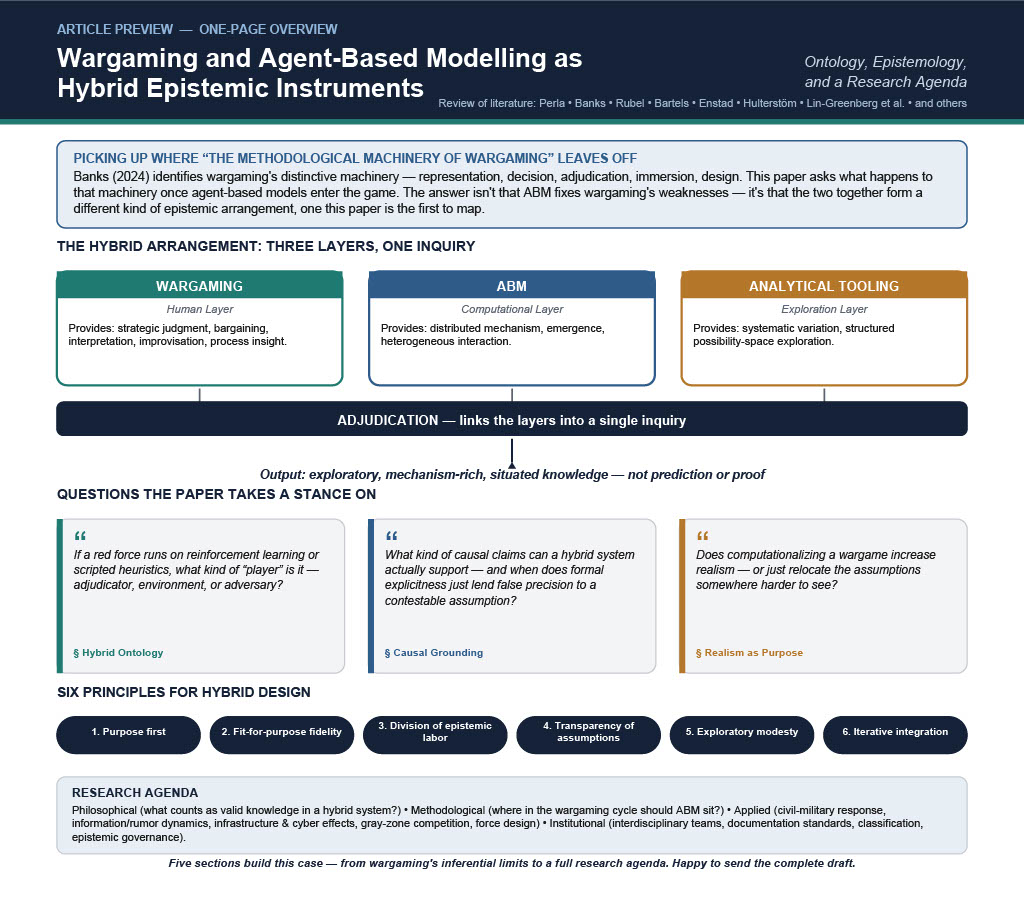
  • Bounded Rationality and Political Agents Human-Machine Strategic Analysis

    Imagine a situation in which a government is sued by a foreign investor under a treaty it signed decades earlier. Before the lawsuit, nobody still in office had ever examined the treaty closely. In one case, a sitting Attorney General had to search “BIT” and “ICSID” online simply to understand what his own government had agreed to (Poulsen & Aisbett, 2013, p. 279). After the lawsuit, however, the same government suddenly began treating every future treaty negotiation as a serious source of legal exposure. Nothing about the underlying risk had changed. What changed was that, for the first time, the risk had become personal, vivid, and impossible to ignore.

    In this case, the problem was not that the government calculated incorrectly. The government had not been calculating at all until circumstances forced it to do so. This is the starting point for this essay because it reflects the kind of behaviour that a fully rational, optimising decision maker should not produce, yet that a bounded rational decision maker produces routinely.

    Theory

    Herbert Simon’s bounded rationality (1957) begins with a simple observation: nobody has the time, information, or computational capacity to identify every possible option in a decision, calculate the full consequences of each one, and then select the true optimum. Real decision makers satisfice. They search until they find an option that clears some internal standard of “good enough,” and then they stop searching rather than continuing until they have proven that it is the best possible choice.

    Mintz’s (2007) manifesto for “Behavioural IR” as a subfield gives this insight its clearest modern expression within international relations. His “Six Characteristics of Behavioural IR” (pp. 159-160) are worth stating in full because they effectively form the definitional core of this essay:

    1. Leaders often make suboptimal rather than utility maximising decisions.
    2. Information processing limits push them toward narrow sets of alternatives and cognitive shortcuts.
    3. Biases operate simultaneously at the individual, group, and organisational levels.
    4. The discipline should study the decision process, not only the outcome.
    5. Rational choice assumes that framing should not matter, yet this assumption is routinely violated.
    6. Loss aversion is central to how leaders, groups, and elites actually make choices.

    Mintz is explicit that this approach is additive and not a rejection of rational choice IR. “IR research can be viewed as consisting of rational choice and nonrational choice (behavioural) paradigms” (p. 158), with the two operating alongside one another rather than one replacing the other.

    Political Mechanism

    The clearest demonstration that bounded rationality is a genuine structural feature of political behaviour comes from Ostrom and Marra’s (1986) study of United States Cold War defence budgeting. Political scientists had spent years failing to find evidence that United States defence spending responded to Soviet spending at all, even though successive administrations repeatedly insisted that it did. Reagan told the United Nations in 1982 that spending is “a measure of intentions,” while his own Defence Secretary stated the point even more directly: “it’s the threat that makes the budget.”

    Ostrom and Marra found the missing reaction once they modelled the budget process as it actually occurred. Instead of treating the process as one actor solving a single optimisation problem each year, they modelled three organisations, the President, Congress, and the Department of Defence, each applying a simple additive “base plus change” rule to whatever the previous actor in the sequence had just done. Each organisation monitored only a narrow and bounded part of the surrounding environment, and none recalculated the entire budget from first principles during every cycle (pp. 821-824).

    Once the process was specified in this way, the model explained the overwhelming majority of the actual increase in defence spending across nearly two decades. It also revealed something more important. Once an inflated estimate of a threat becomes incorporated into an organisation’s baseline, the process contains no mechanism that automatically removes it again, even when the original estimate is later acknowledged to have been wrong (pp. 838-839).

    Poulsen and Aisbett’s (2013) study of how developing countries learn from investment treaty lawsuits provides a test of the same mechanism because it was designed to distinguish bounded rational learning from a fully rational Bayesian alternative. These two explanations can often appear identical when viewed only through their outcomes. Across a panel of 138 countries, a country’s first lawsuit under one of its own treaties reduced its future treaty signing rate by roughly one third. However, the cumulative number of later lawsuits against the same country added almost nothing further to this effect (pp. 291-295). Similarly, a lawsuit brought by investors from a particular partner country had no measurable effect on that country’s willingness to sign new treaties with the same partner (pp. 298 to 301).

    A Bayesian learner should have updated its beliefs in response to all of this information. A bounded rational learner, relying on Tversky and Kahneman’s availability heuristic, updates primarily in response to events that are vivid and personally experienced while largely ignoring information that is less immediate. The authors describe this pattern, not unfairly, as “narcissistic learning.”

    Payne’s (2015) study of United States strategy during the Vietnam War shows the same mechanism operating within individual minds rather than institutions. Robert McNamara’s shift from describing Vietnam as strategically vital to describing Asian trends as “running mostly for, not against, our interests” (p. 156) appears, on the surface, to be a rational response to new evidence. Payne’s argument, however, is that even with extensive documentary access it is empirically impossible to determine whether this reassessment caused McNamara to recognise that the war was being lost, or whether recognising that the war was being lost caused him to reassess its strategic importance (pp. 156-157, 175-176).

    This is the same reference point ambiguity that makes bounded rational explanations and rational explanations constructed with hindsight so difficult to distinguish empirically. Goldgeier and Tetlock’s (2001) review places this issue within the broader context of international relations theory. Bounded rationality is not simply a critique attached externally to realism, liberal institutionalism, or constructivism. Each of these paradigms already contains an often unexamined psychological microfoundation, and bounded rationality is simply the one that realist and institutionalist theories have most consistently neglected.

    Agent Attributes

    An agent designed to satisfice rather than optimise requires a small and specific set of state variables. These variables should deliberately be more limited than those available to a fully rational actor because the purpose of the model is to represent what the agent cannot access, rather than merely describing what it can.

    • An information set: partial and local rather than representing the full state of the world.
    • An aspiration threshold: the standard an option must meet in order to be accepted, rather than a complete ranking of all possible options.
    • A memory base: the previous period’s decision, which is carried forward and adjusted instead of being recalculated from zero. This directly reflects Ostrom and Marra’s “base plus change” logic.
    • A bounded environmental monitoring set: a small and fixed list of variables that the agent actually observes while ignoring everything outside that set.
    • An availability weighting: the degree to which a recent, vivid, and personally experienced event alters the agent’s perception of current risk relative to the true underlying rate.

    Decision Rule

    In plain language, an agent scans a limited set of options in a particular order and adopts the first option that clears its aspiration threshold. It does not compare every available option in order to identify the best one. Its perception of current risk is also not equal to the objective base rate. Instead, that perception is pulled toward similar events the agent has personally and recently experienced. The effect is strong when the event directly involves the agent and weak when the same event merely happens to a comparable neighbour.

    Interaction and Environment

    Two distinct interaction structures appear in the sources discussed above, and a model should choose whichever structure fits the case rather than automatically defaulting to one or the other.

    Ostrom and Marra’s budget process is sequential and hierarchical. Each organisational actor responds primarily to the actor immediately upstream from it, while the range of environmental variables being monitored becomes narrower at every stage of the sequence. The President monitors the broadest set of variables, Congress monitors fewer, and the Department of Defence monitors the narrowest set of all (pp. 823-826).

    Poulsen and Aisbett’s treaty learning process, by contrast, is networked but asymmetric. A shock experienced directly by an agent produces a sharp behavioural update, while a shock experienced by a network neighbour produces almost no response. Both structures provide legitimate ways of modelling interactions among bounded rational agents, and both differ substantially from the assumption found in many simple diffusion models that information originating anywhere in a population should carry roughly equal weight.

    Possible ABM Implementation

    A straightforward way to construct this model would be to create a population of agents that choose in each period among protest, repress, cooperate, and escalate while operating with only partial information about the state of their neighbours and their own recent history.

    Each agent would carry the five attributes described above. Its aspiration threshold and bounded environmental monitoring set could then be varied experimentally in order to examine how the amount of search an agent performs before satisficing affects outcomes at the system level.

    Luteijn’s (2015) generative model of major power war already implements bounded rational state agents along broadly similar lines and therefore provides a useful existing reference point. NetLogo remains the most accessible environment for an initial prototype. A later move to Mesa or a custom framework would become useful once the sequential interaction structure, rather than a flat population, becomes central to the research question.

    Observable Emergent Outcomes

    Two patterns are particularly worth designing the model to identify because both are counterintuitive and both are directly supported by the sources discussed above rather than merely being theoretically plausible.

    The first is path dependence. Because agents satisfice and update from a running base instead of optimising again from the beginning during every period, early and sometimes arbitrary choices can lock the system into an aggregate trajectory that a fully rational population would not have followed. Once established, that trajectory can resist correction even after the information that originally produced it is shown to be wrong. This is exactly what Ostrom and Marra found in the case of the Soviet spending overestimate, which remained embedded in the United States defence baseline rather than being removed once its inaccuracy became clear.

    The second pattern follows directly from Poulsen and Aisbett’s dyadic finding. A population of these agents should display almost no diffusion of caution through indirect experience among network neighbours, while simultaneously showing a very strong reaction to shocks that agents experience personally. This produces a clear and falsifiable prediction that a purely Bayesian population of agents would not generate.

    Limits

    The main difficulty with bounded rationality as a modelling assumption is the problem that Poulsen and Aisbett designed their research to address. In most settings, a bounded rational explanation and a fully rational explanation under imperfect information appear observationally identical from the outside (Meseguer, 2006, discussed at pp. 275, 296 to 301).

    Without some structural feature in the data that forces the two explanations apart, as the bilateral and dyad specific structure of investment treaties does in their study, a model claiming to demonstrate bounded rationality may simply be demonstrating rational behaviour under informational conditions that the modeller has not fully specified.

    This is the central caution of the essay, and it extends beyond this particular theory. An aspiration threshold, a memory base, or an availability weight inserted into a model without empirical grounding for its specific value does not necessarily perform meaningful behavioural work. Without such grounding, these features risk becoming psychological decoration expressed in the language of a formal model while explaining nothing that a simpler assumption could not explain equally well after the fact.

    Model Idea

    Agents choose between protest, repress, cooperate, and escalate according to a satisficing threshold applied to partial information that is weighted toward local and personally experienced events. Each period’s position is constructed from the previous period’s base plus a bounded change term rather than through complete optimisation across the entire option set.

    Further Reading

    • Goldgeier, J. M., & Tetlock, P. E. (2001). Psychology and international relations theory. Annual Review of Political Science, 4(1), 67 to 92.
    • Mintz, A. (2007). Why behavioral IR? International Studies Review, 9(1), 157 to 162.
    • Ostrom, C. W., Jr., & Marra, R. F. (1986). U.S. defense spending and the Soviet estimate. American Political Science Review, 80(3), 819 to 842.
    • Payne, K. (2015). The Psychology of Strategy: Exploring Rationality in the Vietnam War. Oxford University Press.
    • Poulsen, L. N. S., & Aisbett, E. (2013). When the claim hits: Bilateral investment treaties and bounded rational learning. World Politics, 65(2), 273 to 313.
    • Simon, H. A. (1957). Models of Man: Social and Rational. Wiley.

    The next essay in this series takes the same agent and asks what happens when its information is not merely partial but systematically distorted, with availability, representativeness, and anchoring functioning as decision rules in their own right. That comes next: Heuristics and Biases as Agent Rules.

  • ABM: Strategy as Interaction, Not Linearity

    In the weeks before a rebellion, a city can look calm. People go to work, queue at markets, nod to police at checkpoints. Ask any one of them what they think of the regime and you might hear something far angrier than anything visible on the street. Then, one day, seemingly out of nowhere, a crowd forms, and within hours a neighbourhood that looked pacified for a decade is in open revolt.

    Analysts explaining the moment afterward tend to reach for a trigger like a single killing or a fuel price hike. There usually is one, but the trigger is rarely the interesting part. The interesting part is why a population that seemed compliant a week earlier turned out to be sitting on a reservoir of grievance nobody had measured, and why the same trigger, a year earlier or a year later, might have produced nothing at all.

    Most strategic analysis explains moments like this with a linear story: grievance built up, a trigger arrived, the population responded. It’s an intuitive shape for a narrative, and it fits neatly into a policy brief. But it treats a population as a single actor with a single grievance level, and it treats the outcome (revolt or no revolt) as a fairly direct function of how bad things had gotten. If the linear story were right, you could read a population’s mood, plot its trajectory, and get a reasonable forecast of when it boils over.

    That’s roughly the assumption behind the tools political science has historically reached for to study conflict: statistical regressions relating measured national indicators to conflict onset, or formal game-theoretic models that solve for a single equilibrium outcome given a specified set of payoffs. Both are useful. Both also require something the linear story needs to be true which is that the relevant unit of analysis behaves roughly as one actor, and that history unfolds close to its expected path (Masad, 2016, pp. 1–3). Agent-based modelling exists because that assumption usually isn’t true, and because the actual texture of political interaction which is actors watching each other, copying each other, retaliating, changing their minds when the person next to them changes theirs, disappears the moment you average everyone into a single number.

    Agent-based modelling starts from the opposite assumption. Instead of one actor with one grievance level, you build a population of individuals, each with their own circumstances, their own tolerance for risk, and crucially only a local view of what everyone around them is doing. Each one follows a simple rule for how to behave given what it can see. Then you run the simulation and watch what happens at the level of the whole system.

    This sounds like a modest change but it isn’t. Once agents are heterogeneous, locally informed, and reactive to each other rather than to a global average, the link between individual circumstance and collective outcome stops being linear and in some cases stops being predictable from the input parameters at all. Lars-Erik Cederman’s GeoSim model, built to explain why wars follow a power-law size distribution found that this pattern emerges from roughly two hundred interacting, spatially situated states without any actor or mechanism in the model aiming to produce a power law. It’s a signature of what physicists call self-organised criticality: a system that organises itself, through purely local interactions, into a state where a small disturbance can occasionally cascade into a very large one, for reasons that have nothing to do with the size of the disturbance itself (Cederman, 2003, pp. 135–137). You don’t get that kind of finding from a model that treats the international system as one actor solving one equation. You need agents reacting to their neighbours.

    The same logic runs through a wider range of agent-based work in international relations. Bearce and Fisher’s (2002) model of trade and war makes the point explicitly: conventional econometric approaches “treat either trade or war as exogenous, ignoring that both are emergent, endogenous processes influenced by the international system and state behaviour” (p. 365). Their model lets trading networks and war both emerge from the same underlying state-level interactions, rather than assuming one causes the other from outside the system. Robert Axelrod’s work on the evolution of cooperation makes a related point from the opposite direction: strategies like tit-for-tat, and the social norms that stabilise cooperation once punishment becomes decentralised and self-enforcing, were not designed by anyone emerged from thousands of local, myopic interactions among simple agents (Axelrod, 1998, pp. 40–68). Ian Lustick’s ABIR model of identity formation found something similarly non-obvious: give agents a moderate repertoire of possible identities rather than a single fixed one, and inter-group tension drops sharply but push the repertoire size too far and the population fragments instead of consolidating, a curvilinear relationship nobody wrote into the model’s rules on purpose (Lustick, 2000).

    What unites these examples is a shared method: specify how individual actors behave locally, let the interactions run, and treat whatever pattern shows up at the system level as something to be explained rather than assumed. That shift from modelling outcomes directly to modelling the interactions that produce them is what agent-based modelling actually offers strategic analysis. It isn’t a better crystal ball but it’s a different question.

    Nowhere is this clearer than in Joshua Epstein’s (2002) model of civil violence, still one of the most cited agent-based models in political science two decades on, precisely because it is so simple and so revealing. Epstein’s isn’t a model of any specific uprising. It’s a stylised population scattered across a grid, each agent carrying two properties: a level of hardship, and a level of risk aversion. Each agent’s grievance is a simple function of its hardship and its view of the regime’s legitimacy. High legitimacy suppresses grievance even under real hardship; low legitimacy inflames it (Epstein, 2002, p. 7243). Police agents patrol the same grid and arrest active rebels they can see. Every agent’s decision to openly rebel or stay quiet comes down to one comparison: is my grievance bigger than my locally perceived risk of arrest, estimated by looking at how many police versus how many other rebels I can currently see around me?

    That’s the entire rule set. No agent has a theory of revolution. No agent is trying to organise anything. And yet, run over enough cycles, this population reliably produces patterns that look uncannily like real political upheaval which are patterns Epstein never told the model to produce.

    The first is deception. Highly aggrieved agents surrounded by police stay quiet, not because their grievance has changed but because their locally perceived arrest risk is high. The moment police move on, the same agents turn openly rebellious. Nothing in the model represents “concealment” as a strategy; it falls straight out of the arithmetic of the activation rule. A society under this model can look completely pacified while harbouring grievance that surfaces the instant the visible threat lifts (Epstein, 2002, p. 7245).

    The second is cascade. If a few agents happen to cluster somewhere with few police nearby, the local police-to-rebel ratio drops, which lowers the perceived risk for everyone nearby, which draws in agents previously too cautious to act, which lowers the ratio further still. This is why authoritarian regimes so consistently restrict assembly: the model shows, mechanistically, why a crowd is dangerous to a regime in a way the same number of individually aggrieved but dispersed people is not (Epstein, 2002, p. 7245).

    The third is the least intuitive and the most useful for an analyst. Epstein compared what happens when a regime’s legitimacy erodes gradually against what happens when it drops suddenly by the same total amount. Gradual erosion barely moves the needle. The most aggrieved individuals cross their threshold one at a time and get arrested before enough of them cluster to trigger a cascade. A sudden shock of the same total size does the opposite: many agents cross the threshold simultaneously, overwhelming local policing before it can respond, and the cascade dynamic takes over. Epstein calls the gradual version a “salami tactic” — a regime can lose an enormous amount of legitimacy, sliced thin enough, and never face a large uprising for it (Epstein, 2002, p. 7247). The rate of change, not the total change, is what matters. A parallel result holds for repression: gradual liberalisation, not gradual crackdown, is what tends to push the system past its tipping point which is a computational echo of Tocqueville’s observation that revolutions tend to arrive not at the peak of repression but just as it starts to ease (Epstein, 2002, pp. 7247–7248).

    None of this was programmed in directly as those are outcomes of the model, not inputs to it, which is exactly the distinction the whole method depends on. Epstein’s own extension of the model to interethnic violence adds one more result worth sitting with: when he varied the density of peacekeeping forces meant to prevent escalation into genocide, more peacekeepers did, on average, buy more time before catastrophe but the variance around that average grew just as fast as the average itself. At every force level he tested, some runs collapsed into genocide almost immediately and others held for the full length of the simulation. Force size alone did not predict which (Epstein, 2002, pp. 7249–7250).

    None of this tells an analyst when the next uprising will happen. That’s precisely the point, and precisely the value. What Epstein’s model offers instead is a different set of questions to ask about a population that looks stable.

    First: stability is not evidence of consent. A population showing no visible unrest can still be sitting on concealed grievance that a change in visible enforcement (a troop withdrawal, a policing gap, a moment of regime distraction) could expose all at once. Second: watch the rate of change in the signals that matter, not just their level. A slow, sustained erosion of legitimacy or living standards may be more survivable for a regime than a single sharp shock a fraction of the size, because gradual decline lets a state pick off would-be catalysts one at a time before they cluster. Third: be suspicious of any claim that a fixed intervention size (a peacekeeping force, a troop surge, a sanctions package) guarantees a predictable outcome. Epstein’s model shows the same intervention, at the same scale, producing wildly different timelines to catastrophe depending on essentially where and when local clustering happens to occur. An analyst briefing a decision-maker on force sizing should be honest that more generally helps on average, while being explicit that “on average” is doing a lot of work in that sentence.

    None of this should be mistaken for a validated theory of revolution. Epstein is explicit that hardship, legitimacy, and risk aversion in his model are stylised constructs, not measured quantities. The model is a thought experiment about mechanism, not a calibrated forecasting tool (Epstein, 2002, p. 7250). That caution generalises across the method. Agent-based models are only as good as the behavioural rules built into them, and those rules are frequently unvalidated assumptions dressed up in the language of a formal model. Even ambitious, well-resourced attempts to bring empirical rigour to agent-based conflict models run into this wall: Devon Masad’s (2016) attempt to reimplement and validate Bruce Bueno de Mesquita’s widely cited Expected Utility Model (a model that has actually been used for real policy forecasting) could not fully reproduce the original’s own published results, in part because the original was never fully specified or made transparent (Masad, 2016, pp. 94–101). If a model already in policy use can’t be independently verified against its own claimed outputs, that’s a serious caution against treating any single agent-based model’s results as settled fact.

    Cederman and Girardin (2023), reflecting on their own decades of work in this field, make the same point from the inside: the abstraction that gives agent-based models their explanatory power is also what limits their empirical validation and their influence on policy which is part of why the field shifted toward pairing ABM with spatial, empirically grounded data in the 2000s rather than relying on pure simulation alone. The question to ask of a model like Epstein’s isn’t whether to trust it outright, but the same question you’d ask of a single dramatic case study: is this one plausible mechanism among several, or the mechanism? Usually it’s the former which is exactly what makes it worth thinking with, and exactly why it should never be the only thing you think with.

    Go back to the city that looked calm the week before it wasn’t. The linear story says the trigger caused the revolt. The interaction story says something closer to the truth: a population of people, each reading the risk on their own street corner, had been sitting one shock away from a cascade for longer than anyone watching from outside could have known. The trigger didn’t create the grievance. It just told everyone, all at once, that the street corner next to them was ready too.

    The next piece in this series looks at what’s actually inside an agent like the ones in Epstein’s model: the decision rule itself, and how bounded rationality rather than not full optimisation, is what makes an agent like this behave the way it does. That’s next: Bounded Rationality and Political Agents.

    Further reading

    Axelrod, R. (1998). The Complexity of Cooperation: Agent-Based Models of Competition and Collaboration. Princeton University Press.

    Bearce, D. H., & Fisher, E. O. N. (2002). Economic geography, trade, and war. Journal of Conflict Resolution, 46(3), 365–393.

    Cederman, L.-E. (2003). Modeling the size of wars: From billiard balls to sandpiles. American Political Science Review, 97(1), 135–150.

    Cederman, L.-E., & Girardin, L. (2023). Computational approaches to conflict research: From modelling and data to computational diplomacy. Journal of Computational Science.

    Epstein, J. M. (2002). Modeling civil violence: An agent-based computational approach. Proceedings of the National Academy of Sciences, 99(Suppl 3), 7243–7250.

    Lustick, I. S. (2000). Agent-based modelling of collective identity: Testing constructivist theory.

    Masad, D. P. (2016). Agents in Conflict: Comparative Agent-Based Modelling of International Crises and Conflict [Doctoral dissertation, George Mason University].

  • Network Analysis: Seeing Power as Position

    Human–Machine Strategic Analysis · New Tools for Strategic Analysis

    Power is usually measured by what states possess. Network analysis asks a different question: where do they sit, who depends on them, and what happens when their position is removed?

    In March 2012, a handful of Iranian banks found themselves cut off from a system most people have never heard of. Every economy on Earth depends on it. There were no warships blockading a port and no embargo announced with fanfare. A cooperative headquartered outside Brussels simply voted, and Iran’s financial institutions could no longer send or receive the messages that authorize a cross-border transaction. The system was SWIFT, the Society for Worldwide Interbank Financial Telecommunication. Acting under EU regulation passed in response to US pressure over Iran’s nuclear program, SWIFT disconnected roughly thirty Iranian banks from its network in March 2012 (Farrell & Newman, 2019, pp. 68-69).

    Iran’s oil reserves had not moved. Its military had not shrunk. Its diplomatic standing, such as it was, was not the trigger. What changed was Iran’s position in a network of financial messaging that has no real substitute. An EU official at the time called it “a very efficient measure… it can seriously cripple the banking sector in Iran” (Gladstone & Castle, 2012, as cited in Farrell & Newman, 2019, p. 69). Unwinding the SWIFT ban became a central bargaining chip in the nuclear negotiations that followed. A cooperative most readers have never heard of had more leverage over Iran’s economy in that moment than most of its conventional military assets combined.

    Power as a Stockpile

    Most power analysis still counts. It counts GDP. It counts military spending as a share of GDP. It counts divisions, carrier groups, and population. This is the implicit ledger behind most net-assessment exercises, most “who is winning” journalism, and most first-year international relations teaching. Power is treated as a stockpile, and stockpiles can be ranked.

    Iran’s case does not fit that ledger. Nothing on Iran’s capability sheet moved. What moved was something the sheet does not measure at all: Iran’s location within a structure of financial dependence that Iran did not build, does not control, and cannot easily exit.

    Power as Position

    Hafner-Burton et al. (2009) gave this intuition a name and a structure. They defined power as a function of network position, and they identified three distinct versions of it (pp. 570-573). Access power belongs to well-embedded nodes that can draw on resources and shape information flow simply by being connected. Brokerage power belongs to nodes that bridge otherwise disconnected clusters. A colonial power, for example, gains leverage not from raw capability, but from being the only connective tissue between colonies that have no ties to each other. Exit-option power belongs to marginal, weakly embedded actors who can credibly threaten to leave a network altogether. Tellingly, the authors’ own illustration of that third category contrasts Iran’s comparatively open exit options with North Korea’s near-total dependence on China (pp. 572-573). This is the same state, and years before the same kind of network coercion this piece opens with.

    The clearest statement of why position works this way comes from sociology, four decades earlier. Granovetter (1973) showed that strong ties cluster into dense, overlapping cliques. It is the weak ties that connect otherwise separate clusters. People find jobs, ideas, and opportunities disproportionately through those weak ties, because acquaintances sit in different circles and carry different information. A node that bridges two otherwise disconnected parts of any network, whether financial, social, or geopolitical, has influence that has nothing to do with its size. Its influence comes from the fact that other actors cannot get from A to B without going through it. Network theory has a precise name for this: betweenness centrality. It is the same property that makes a single airline hub going offline so disruptive (Victor & Khwaja, 2020). SWIFT’s leverage over Iran, in this vocabulary, is nothing more exotic than a very high betweenness score.

    Farrell and Newman (2019) turned this into an explicit theory of coercion. Global economic networks, they argued, do not stay flat and reciprocal the way classical liberal theory expected. They reliably collapse into asymmetric hub-and-spoke structures. States that hold jurisdiction over the resulting hubs, and have the domestic institutions to act on it, gain two distinct tools. The first is the panopticon effect, an information advantage from data passing through the hub. The second is the chokepoint effect, the ability to cut others off entirely (pp. 54-56). This is a third category of power, separate from market size and from ordinary bilateral dependence. It is power that comes specifically from centrality.

    Being well-connected, however, is not automatically the same as being powerful. Bonacich’s classic refinement of centrality, as summarized by Izquierdo and Hanneman (2006 explains being tied to well-connected, independent partners makes an actor central. Being tied to dependent partners with nowhere else to go is what makes an actor powerful. SWIFT is powerful not because it is large, but because so many dependent institutions have no alternative route around it. Conventional power-counting asks how much an actor has. Network analysis asks what would be cut off, and for whom, if that actor’s position were denied. These are different questions, and 2012 Iran is the proof.

    The SWIFT Precedent

    SWIFT’s centrality was not designed but it emerged. Before the 1970s, cross-border bank communication ran over slow, insecure telegram and telex networks. A handful of banks built SWIFT to replace them. It grew from a few hundred member firms in 1977 to over 11,000 institutions worldwide by 2016 (Farrell & Newman, 2019, pp. 58-60). Nobody set out to build a chokepoint but efficiency did.

    That efficiency became leverage in two distinct stages. After the September 11 attacks, the US Treasury began compelling SWIFT transaction data to trace terrorist financing. This was the panopticon effect, and it operated for over a decade largely out of public view (Farrell & Newman, 2019, p. 67). The chokepoint effect arrived later, and it needed something the panopticon effect did not: coordinating institutional capacity across two jurisdictions. SWIFT sits on EU soil, so the US alone could not compel it to act. It took a US Senate threat combined with an EU Council regulation to force the 2012 disconnection (Farrell & Newman, 2019, pp. 67-68).

    That combination of jurisdiction and institutional capacity turns out to be the general mechanism behind coercive network power, not just SWIFT’s particular case. Hafner-Burton and Montgomery (2012) tested the standard liberal-peace claim that shared trade-agreement membership reduces conflict. They found that the claim only holds when dependence between two states is roughly symmetric. Where one state depends on a trading partner far more than that partner depends on it, conflict risk rises rather than falls, and the effect is larger than the pacifying effect of membership itself. Real, named disputes bear this out among states that were simultaneously trade-agreement co-members, including Armenia and Azerbaijan, India and Pakistan, and the two Koreas. Shared membership only became leverage when it produces asymmetric dependence. Even then, using it requires matching institutional capacity, not just jurisdiction.

    The 2018 coda sharpens the point. When the US withdrew from the Iran nuclear deal and moved to reimpose sanctions, French Finance Minister Bruno Le Maire objected that the US was not “the economic policeman of the planet” (as cited in Farrell & Newman, 2019, p. 42). Yet the EU’s fragmented regulatory structure meant it had no real counter-move. It could protest. It could not disconnect. The position that let the US and EU jointly weaponize SWIFT against Iran in 2012 is the same position that left the EU unable to stop the US from threatening to do it again in 2018, this time without EU agreement.

    When Structure Out-Predicted Power

    A second, independently validated case makes the same point more starkly, because it strips away every psychological and institutional wrinkle SWIFT carries. Axelrod and Bennett (1993) modelled alliance formation with almost nothing but position. In their landscape theory of aggregation, each actor compares itself to every other actor pairwise, never to the group as a whole, and switches sides incrementally whenever doing so reduces its own local tension with its surroundings. There is no negotiation and no strategic calculation. There are only short-sighted, locally rational moves that mechanically pull the whole system toward a stable configuration.

    The authors applied this model to the seventeen major European powers before the Second World War, using only pre-war data on ethnic ties, religion, borders, regime type, and history of conflict. The model correctly predicted the wartime alignment of all but two states. A pure capability-counting baseline, which treated every state as equally distrustful of every other, matched none of them. Run unchanged on nine computer manufacturers competing to set a technology standard in 1988, the same formalism correctly predicted most of the resulting alliance structure from market position alone. Position and structure predicted real outcomes years in advance, across two unrelated domains. Raw power comparison did not.

    The theory also explains why some alignments prove so hard to shift. A system can settle into more than one stable configuration. A small early event can lock it into a worse-than-necessary arrangement. This is the same “frozen accident” logic that explains why the world kept the QWERTY keyboard.

    The Reversal

    A third finding goes further than either case above, because it shows what happens when position is not just left out of an analysis, but actively misrepresented by the method used to study it. Standard statistical treatments of alliance data analyze each pair of states as though its alliance decision were independent of every other pair’s. This assumption sits awkwardly with the fact that alliance blocs visibly react to each other in real time. Historically, the Triple Entente was assembled step by step in direct response to the Triple Alliance forming first (Cranmer et al., 2012).

    Cranmer et al. (2012) re-ran a well-known alliance dataset twice. The first run used the standard, position-blind method. The second used an approach that lets a state’s alliance choices depend explicitly on the choices already made around it, accounting for popularity effects and for states’ real preference for closing triangles by allying with the allies of their allies. Most familiar findings survived the switch. One of the field’s best-established claims did not. The claim that democracies are especially likely to ally with other democracies came out positive under the standard method. It came out negative once alliance interdependence was modeled properly, and the standard method’s estimate of the effect’s size was badly overstated in the process. A textbook finding, cited for decades, reversed sign entirely once network structure was actually accounted for. This is the sharpest available demonstration that ignoring position does not just add noise to an analysis. It can flip the conclusion outright.

    Picking Sides: The Logic of Triangles

    If alliance choices react to each other, one useful answer for how predates network science by decades. In the 1940s, the psychologist Fritz Heider proposed that people seek consistency in how they feel about the people and things around them. Your friend’s friend should be your friend. Your friend’s enemy should be your enemy. An inconsistent arrangement creates real tension that people are motivated to resolve.

    Corbetta and Grant (2012) applied this logic to a common situation in international politics: a state watching two others already locked in conflict, deciding what to do. If the third state is friendly with both disputants, the theory predicts it resolves the tension the cheapest way, through neutral mediation. If it is already friendly with one and not the other, its position is already consistent, and it has every incentive to act on that consistency through partisan intervention on the side of its friend. The authors tested this against the 1962 Sino-Indian War, where outside interventions are a matter of public record. This simple rule correctly predicted most states’ choice of mediator or partisan role from nothing more than the sign of their prior relationships. The same pattern held up statistically across a much larger dataset of Cold War and post-Cold War disputes, though somewhat more noisily in the later period. One result was genuinely surprising: shared regime type between the third party and a disputant did not significantly predict which role a state took. This cuts against a substantial body of research that treats regime similarity as a strong predictor of alignment.

    More Ties, More Conflict

    A separate, system-wide question asks whether more alliance connections overall make the international system more or less conflict-prone. The intuitive liberal answer is fewer disputes. Maoz et al. (2003) tested this across nearly two centuries of data and found the opposite. Years with denser alliance networks saw significantly more militarized disputes, not fewer. A related measure cut the other way: a more polarized system, split into a smaller number of tightly knit blocs, saw fewer disputes than a more loosely fragmented one. This is the opposite of what intuition about polarization would suggest. The same data also extended the well-known finding that pairs of democracies rarely fight each other up to the level of the whole system. The more democracies embedded in a state’s own network of ties, the less conflict-prone that state was. Structure, again, was doing work that a simple count of ties or capabilities would miss entirely.

    What a Rising Power Does With Its Position

    The access-brokerage distinction introduced earlier has a further use beyond explaining a single coercive episode. It helps explain what a rising or dissatisfied power is likely to do next. Political scientist Lauren Goddard, as summarized by Menninga and Goldberg (2022), distinguished a state’s access, meaning how embedded it already is inside existing institutions, from its brokerage options, meaning whether it instead bridges networks that existing institutions do not fully connect. Access gives a state standing to push for reform from within. Brokerage gives it the ability to build alternatives outside the existing order. A state rich in access has every incentive to reform the system it sits inside. A state rich in brokerage options has more reason to route around it and build parallel arrangements instead. Network position, in other words, does not just grant leverage over a single adversary. It shapes whether a dissatisfied power tries to reform, exit, or overturn the order it is embedded in, independent of its raw size.

    Related findings point the same way at smaller scales. Diplomatic recognition spreads through this kind of “friend of my friend” clustering rather than through states’ own attributes. International systems broken into several tightly knit but poorly connected blocs are measurably more conflict-prone than more thoroughly interconnected ones (Menninga & Goldberg, 2022).

    Reading a Network: Three Questions for Analysts

    An analyst trying to map who has power in a given domain should stop starting with capability tables. Three questions work better.

    Where are the hubs? In finance it is SWIFT and dollar clearing. In energy it is chokepoints like the Strait of Hormuz. In data it is a small number of transcontinental cables and cloud providers. The same pattern recurs across very different domains (Farrell & Newman, 2019).

    Who has jurisdiction, and do they have the institutions to use it? Jurisdiction without capacity is inert. This is the EU’s problem with SWIFT. Capacity without jurisdiction is moot. Mapping the two separately avoids assuming that hosting a node is the same as controlling it.

    Is dependence symmetric or asymmetric, and is the actor central or merely well-connected? Symmetric dependence rarely produces conflict. Asymmetric dependence does. Bonacich’s distinction adds a second layer. An actor tied to strong, independent partners is central without necessarily being powerful. An actor whose partners have nowhere else to go is powerful precisely because of that dependence.

    One add-on is worth remembering. The panopticon and chokepoint effects do not automatically travel together. The US has near-total panopticon capability over the internet, but it has largely declined to build matching chokepoint capability there, for ideological and institutional reasons (Farrell & Newman, 2019, pp. 70-74). Any hub-mapping exercise should ask about both effects separately.

    The Limits

    Five real cautions follow:

    Network logic is not one thing. Trade networks form through a rich-get-richer dynamic. Alliance networks form mainly through similarity between partners, and essentially never the other way around (Maoz, 2012). Network power in the Farrell and Newman sense applies cleanly to hub-based systems like SWIFT. It does not automatically transfer to alliance-type networks, and this piece should not imply that one master logic explains both.

    Ties are not always what they look like. Shared institutional membership is a weak, sometimes misleading proxy for a real, influential tie. More than one source in this literature raises this caution independently (Hafner-Burton et al., 2009; Kacziba, 2021).

    The data itself has a blind spot exactly where hub-mapping needs to see clearly. Peripheral, weakly connected nodes are disproportionately the ones that go unrecorded, which mechanically understates a network’s true density and centrality. This is close to the worst-case failure mode for an analysis whose whole purpose is finding the best-connected nodes (Menninga & Goldberg, 2022; Victor & Khwaja, 2020).

    Weaponizing a hub is not free, even for the state doing it. States targeted through network position build workarounds. Russia has explored alternative payment systems, and China accelerated domestic chip manufacturing after being cut off from US suppliers (Farrell & Newman, 2019, pp. 76-77). Network power is real, but using it too aggressively can erode the very structure that generated it.

    Position correlating with an outcome is not proof that it caused it. A node’s central position and its apparent power can both be downstream of some third factor. States with strong institutions may simply be more likely to both occupy hub positions and wield influence, with neither one causing the other. Researchers applying formal sensitivity analysis to two similar-looking claims about how behavior spreads through social networks found that one claim held up against plausible confounders while a near-identical one did not (Victor & Khwaja, 2020). The same method validated one claim and undercut another that looked just as plausible. Nothing in this piece proves that SWIFT’s position caused its leverage rather than merely coinciding with the institutional capacity to use it. The case is compelling because the mechanism is well documented, not because correlation between position and power is self-evidently causal.

    One further clarification belongs alongside these five cautions. Granovetter’s tradition of informational bridging through weak ties and Farrell and Newman’s tradition of coercive chokepoints are related but not identical. Both are about the advantages of a bridging or central position. But “influence flows through weak ties” and “states can coerce through hubs” are structurally similar, analytically separate claims.

    Where This Leaves Us

    Kacziba (2021) surveyed how political scientists have reacted to network methods generally and identified three postures. Some scholars treat network methods as a narrow, borrowed tool. Others treat them as a genuinely expanding methodology. A smaller group holds what Kacziba calls “network idealism,” the belief that network thinking can redefine the field’s grand theories outright. This piece sits in the cautious middle. Network analysis does not replace capability, institutions, or history as explanations for what states do. What it adds is a variable that conventional power-counting cannot see at all. In case after case above, that variable turns out to be doing real, measurable, sometimes decisive work.

    Return, one last time, to 2018. There was the reimposition threat, Le Maire’s line about the economic policeman, and the EU quietly unable to do more than object. The position that gave the US and EU joint leverage over Iran’s economy in 2012 is the same position that left the EU unable to stop the US from threatening to do it again six years later, despite SWIFT sitting on EU soil the entire time. Iran’s oil was where it had always been. Its army was where it had always been. What had changed, in both directions, was never on the capability sheet at all. It was position in a network, and whoever controls that position controls what happens next.

    References

    Axelrod, R., & Bennett, D. S. (1993). A landscape theory of aggregation. British Journal of Political Science, 23(2), 211-233.

    Corbetta, R., & Grant, K. A. (2012). Intervention in conflicts from a network perspective. Conflict Management and Peace Science, 29(3), 314-340.

    Cranmer, S. J., Desmarais, B. A., & Menninga, E. J. (2012). Complex dependencies in the alliance network. Conflict Management and Peace Science, 29(3), 279-313.

    Farrell, H., & Newman, A. L. (2019). Weaponized interdependence: How global economic networks shape state coercion. International Security, 44(1), 42-79.

    Granovetter, M. S. (1973). The strength of weak ties. American Journal of Sociology, 78(6), 1360-1380.

    Hafner-Burton, E. M., Kahler, M., & Montgomery, A. H. (2009). Network analysis for international relations. International Organization, 63(3), 559-592.

    Hafner-Burton, E. M., & Montgomery, A. H. (2012). War, trade, and distrust: Why trade agreements don’t always keep the peace. Conflict Management and Peace Science, 29(3), 257-278.

    Izquierdo, L. R., & Hanneman, R. A. (2006). Introduction to the formal analysis of social networks using Mathematica (Version 2). Universidad de Burgos.

    Kacziba, P. (2021). The network analysis of international relations: Overview of an emergent methodology. Journal of International Studies, 14(3), 155-171.

    Maoz, Z. (2012). Preferential attachment, homophily, and the structure of international networks, 1816-2003. Conflict Management and Peace Science, 29(3), 341-369.

    Maoz, Z., Kuperman, R. D., Terris, L. G., & Talmud, I. (2003, February 21-23). International relations: A network approach [Paper presentation]. Gilman Conference on New Directions in International Relations, Yale University, New Haven, CT, United States.

    Menninga, E. J., & Goldberg, L. A. (2022). Network analysis. In Handbook of research methods in international relations (pp. 489-506). Edward Elgar Publishing.

    Victor, J. N., & Khwaja, E. T. (2020). Network analysis: Theory and testing. In L. Curini & R. Franzese (Eds.),

  • Inferring the Unknowns: A Network Analysis of Cyber Incidents

    Research Extension · Cyber · Network Analysis · Computational Methods

    Empirical methods paper · December 2025 · approx. 4,900 words

    Abstract

    Cyber-conflict research faces an unusual empirical problem: much of the information researchers would most like to observe is missing, uncertain, contested, or deliberately concealed. Rather than treating this missingness purely as a limitation, this paper asks whether network structure can help interpret these structured unknowns.

    Using the Cyber Events Database, the study represents cyber incidents relationally by connecting attributes including actor type, target industry, event subtype, motive, target country, and actor country. Network measures and community detection are used to identify recurring structures within known incidents, after which an exploratory inference procedure evaluates unknown attributes according to their structural proximity to observed categories.

    The results suggest that missing cases often align with dominant incident ecosystems, particularly criminal-financial activity and high-frequency exploitation patterns. At the same time, the exercise reveals an important limitation: network inference tends to reproduce the dominant structure of the underlying dataset and may therefore amplify reporting biases or struggle to detect genuinely novel threats.

    The paper is best understood as a proof of concept for treating uncertainty itself as relational information rather than simply discarding incomplete observations.

    The paper therefore deliberately opts for a methodological proof of concept rather than causal inference or prediction.

    Research Question

    How can network analysis help interpret structured unknowns in cyber incidents?

    Method

    01 — Cyber Incident Data

    The study uses the Cyber Events Database, containing 14,981 raw incident observations before cleaning.

    02 — Relational Representation

    Cyber incidents are transformed into a multipartite network connecting actor types, motives, event types, industries, target countries, and actor countries.

    03 — Structural Analysis

    Centrality measures and Louvain community detection are used to identify prominent categories, connectors, and recurring incident ecosystems.

    04 — Relational Inference

    Undetermined values are evaluated against the observed network context of each incident. Candidate categories with the strongest weighted connections to the incident’s known attributes are treated as the most plausible structural match.

    The inference process is thus relational and probabilistic in nature; it makes no claim to definitive attribution.

    What the Analysis Found

    The inferred unknowns concentrate strongly around already dominant nodes in the network. Criminal actors and financial motives dominate many inferred cases, while common exploitation methods and major target environments also receive disproportionate weight.

    At the geopolitical level, the procedure frequently aligns unknown target cases with the United States and unknown actor-country cases with Russia. These results should not be interpreted as definitive attribution. They partly reflect the structure and reporting biases of the underlying dataset.

    Network inference is better at locating unknowns within known structures than at discovering genuinely new structures.

    That is the primary methodological limitation. The paper explicitly concludes that the model reproduces existing patterns more easily than it detects new or under-reported threats.

    Why This Matters

    The methodological interest of the paper lies less in any individual inferred cyber incident than in a different way of thinking about missing data.

    Cyber missingness is often politically structured: secrecy, attribution problems, uneven reporting capacity, and strategic incentives affect what becomes observable. A relational approach therefore asks whether missing information can sometimes be interpreted through the wider patterns in which it is embedded.

    This shifts the analytical emphasis away from treating cyber incidents as isolated observations and toward understanding cyberspace as a structured system of recurring relations and co-occurrences.

    Why I Am Returning To This

    This project was an early empirical exploration of the broader network perspective that now forms a larger part of my research agenda.

    Its strongest contribution is not the specific inference procedure itself, which remains deliberately exploratory. Instead, it demonstrates how network thinking changes the kinds of questions that can be asked about incomplete political data.

    The project therefore connects naturally to my current work on network theory, computational methods, epistemic uncertainty, and the distinction between identifying statistical patterns and producing defensible explanations. Future versions could improve the inference procedure, use longitudinal networks, compare alternative cyber datasets, and examine whether similar relational approaches can be used in other politically opaque domains.

    Related Research Directions

    02 — Network Analysis & International Relations

    The paper is an empirical example of treating observations as components of a wider relational system.

    07 — Philosophy of Computational Social Science

    Its treatment of missingness, uncertainty, inference, and the limits of computational conclusions connects directly to questions about what computational evidence can justify.

    Read the Original Paper

    This is the original December 2025 research paper. The network-inference approach is exploratory and its outputs should be interpreted as structural associations rather than definitive attribution.

  • Wargaming and Agent-Based Modelling as Hybrid Epistemic Instruments: Ontology, Epistemology, and a Research Agenda

    Note: The above picture has been generated with Claude to have a visual overview of the full paper. All text in this post and the paper itself are human-written.

    Research Extension · Wargaming · Agent-Based Modelling · Human–Machine Systems

    Long-form research article · approx. 8,400 words

    Abstract

    Wargaming and computational simulation are increasingly being combined in military, policy, and research environments, yet their integration is often discussed primarily as a technical problem. This paper argues that combining wargaming with Agent-Based Modelling creates something more consequential: a hybrid epistemic arrangement in which human players, computational agents, adjudication systems, and analytical tools perform different forms of epistemic work.

    The paper first reconstructs the ontology and epistemology of wargaming, emphasizing its strengths in eliciting strategic judgment, deliberation, interaction, and decision-making under uncertainty, while identifying limitations including adjudicative opacity, weak mechanism specification, restricted systematic variation, and difficulties representing distributed background dynamics. It then examines ABM as a generative and exploratory method capable of formalizing heterogeneous interaction, emergence, and repeated exploration, while introducing its own challenges of abstraction, validity, representation, and interpretation.

    Rather than presenting ABM as a replacement for human-played wargaming, the paper proposes an integrated framework in which each method is assigned tasks suited to its epistemic strengths. It concludes by developing a research agenda for the philosophical, methodological, applied, and institutional design of hybrid human-computational wargaming systems.

    The paper itself explicitly frames this contribution as a shift from the question of whether ABM can “improve” wargaming to the question of what kind of knowledge the combination can produce and how the epistemic work is distributed among the components.

    Key Argument

    The important question is not whether computation can be added to a wargame. It is which forms of judgment, representation, mechanism, and inference should be assigned to humans, models, adjudicators, and analytical systems.

    Why Hybridise?

    Wargaming Contributes

    • Situated human judgment
    • Strategic interaction
    • Interpretation and improvisation
    • Bargaining and role conflict
    • Deliberative and process insight.

    ABM Contributes

    • Explicit mechanisms
    • Heterogeneous interaction
    • Distributed background dynamics
    • Emergence and nonlinear effects
    • Eepeatability and sensitivity analysis
    • Systematic exploration of assumptions.

    The methods therefore have different comparative advantages. Wargaming is especially useful for exploring what strategic actors do when they confront one another under uncertainty and consequence. ABM is especially useful for examining the macro-patterns that may emerge from many interacting actors operating under specified rules and conditions.

    What The Paper Does

    01 — Reconstructs Wargaming

    Examines what kind of object a wargame is and what kinds of knowledge it can legitimately produce.

    02 — Identifies Its Inferential Limits

    Focuses on adjudication, mechanism specification, systematic variation, participant dependence, background dynamics, and institutional assumptions.

    03 — Reconstructs ABM

    Treats Agent-Based Modelling as a generative and exploratory instrument rather than a forecasting machine.

    04 — Proposes a Hybrid Framework

    Explains how different epistemic tasks can be allocated across human players, computational agents, adjudication, and analysis.

    05 — Builds a Research Agenda

    Identifies philosophical, methodological, applied, and institutional questions that need to be answered before hybrid systems can be treated as defensible analytical instruments.

    Practical Implication

    Hybrid design should begin with the substantive problem rather than the available technology. Strategic bargaining, role conflict, interpretation, and improvisation may be better represented through human players, while information diffusion, civilian response, infrastructure cascades, or other distributed dynamics may sometimes be better represented computationally.

    The task is therefore not to automate as much of the wargame as possible. It is to decide deliberately where human judgment adds value, where formal modelling adds value, and how conclusions should be drawn from the combined system.

    Why I Am Returning to This

    This paper sits directly at the intersection of several strands of my current research. It connects wargaming and Agent-Based Modelling to the wider problem of human-machine strategic analysis, while also raising the philosophical question that underlies much of my work: what can computational models actually tell us, and under what conditions should their outputs affect strategic judgment?

    I therefore see the paper not as a finished endpoint, but as the starting point for further work on hybrid simulation environments, computational adjudication, expert-model interaction, validation, and the deliberate allocation of analytical tasks between humans and machines.

    Related Research Directions

    01 — Wargaming, AI & Simulation
    Primary substantive research direction.

    04 — Human-Machine Collaboration
    The paper is fundamentally concerned with the distribution of analytical and epistemic work between humans and computational systems.

    06 — NetLogo & Agent-Based Modelling for International Relations
    Provides the broader ABM connection and a route toward developing concrete models.

    07 — Philosophy of Computational Social Science
    Directly concerned with ontology, epistemology, explanation, validation, and inference.

    Read the Original Paper

    The paper below presents the full argument and research agenda. It is retained as a long-form research document and may form the basis of later, more focused pieces.

  • From Network Analysis to Network Theory: Toward a Relational Theory of International Politics

    Research Extension · Network Analysis · International Relations Theory

    Original research paper · approx. 3,500 words

    Abstract

    This paper asks whether network analysis in international relations can be developed beyond its conventional role as a methodological toolkit into a substantive relational theory of international politics. Its central premise is that international outcomes are shaped not only by actors’ internal characteristics or aggregate capabilities, but by the positions they occupy within overlapping military, economic, institutional, technological, financial, and ideational networks.

    The paper distinguishes between network ontology, network theory, and network analysis, and argues that the theoretical contribution emerges when relational structures are connected to identifiable political mechanisms. It develops a middle-range framework centred on how network position converts resources into influence, creates asymmetric dependence and vulnerability, shapes the transmission of shocks and ideas, and generates emergent structures through repeated interaction and feedback.

    Rather than claiming that network theory should replace existing approaches to international relations, the paper proposes it as a complementary explanatory framework. Its broader aim is to move from simply measuring centrality, brokerage, density, or clustering toward explaining when and why those relational properties produce politically consequential outcomes.

    Key Argument

    Capabilities do not translate into political effects independently of relationships. Their strategic value depends partly on where actors sit, what flows through their connections, what alternatives exist, and which relational mechanisms those positions activate.

    The Framework

    01 — Positional Conversion

    Network position affects how effectively actors can convert existing resources into political influence.

    02 — Dependence & Substitutability

    Dependence becomes politically consequential when relationships are asymmetric and costly to replace.

    03 — Transmission & Diffusion

    Networks shape how shocks, ideas, policies, technologies, conflict, and cooperation travel through the international system.

    04 — Emergence & Feedback

    Repeated relational choices generate wider structures, which subsequently reshape the incentives and opportunities facing actors.

    Multiplexity functions as a conditioning principle: the political effect of an actor’s position in one network may depend on its position in other network layers.

    What This Paper Contributes

    The paper attempts to specify what would be required for a genuinely network-theoretical explanation in international relations. Rather than treating centrality or other network measures as self-explanatory variables, it links actors and attributes, ties and their substantive content, structural positions, relational mechanisms, and political outcomes within one explanatory architecture.

    It also treats network theory explicitly as a middle-range theory: useful where actors are meaningfully interdependent and network positions structure access, alternatives, dependence, or transmission, but not as a universal explanation of international politics.

    The original paper therefore concludes with a six-step strategy for operationalization: define the political outcome and the relational system, identify the relevant position, specify the mechanism and scope conditions, and determine which empirical observations can support or undermine the explanation.

    Why am I Returning to This

    This paper marks a shift in my thinking about network analysis. Rather than treating networks primarily as another quantitative method to apply to particular cases, I am increasingly interested in whether relational structure can provide substantive theoretical explanations of international politics.

    The framework developed here therefore connects directly to my broader work on network analysis, geo-economics, international order, and the methodological relationship between structure and strategic decision-making. Future work can test and refine these propositions through empirical cases and connect the framework more explicitly to simulation and other computational approaches.

    Related Research Directions

    02 — Network Analysis & International Relations
    Primary connection. This paper develops the theoretical foundations underlying that research direction.

    07 — Philosophy of Computational Social Science
    The distinction between measurement and explanation, the use of mechanisms, scope conditions, and falsifiability connect the paper directly to broader questions about computational explanation.

    Read the Original Paper

    The document below is the original research paper. I present it here as part of an ongoing research agenda; the ideas may be revised or extended in future work.

  • One Month In, Iran Has Shifted the War From Missiles to Markets 

    April 2026

    NOTE ON SOURCES: Since the start of the war, I’ve woken up almost every day by reading the Institute for the Study of War’s daily Iran updates. Over time, those reports became the backbone of how I followed the conflict: not as isolated headlines, but as a running picture of how the war was evolving militarily, politically, economically, and regionally. This article grows out of that habit. It is not a day-by-day reconstruction and it does not cite each individual update in the text. Instead, it is a synthesis of the main patterns, shifts, and implications that stood out over the first month of the war. For news reporting and consistency across key developments, I also relied heavily on Reuters, alongside a number of other sources listed at the end. The interpretation, framing, and conclusions are my own. 

    A month into the US-Israeli war against Iran, the most important analytical mistake is to judge the conflict only by what happened in the military theatre.  In that regard, the US and Israel have clearly won the opening phase. Looking at the past month, we have seen a campaign that quickly degraded Iranian air defences, missile launchers, command-and-control nodes, naval assets, internal security institutions, and parts of the defence-industrial base. Iran as absorbed severe damage and lost much of the conventional comfort zone that once protected its military infrastructure. Yet that is not the same as saying the Trump and Netanyahu are winning. Iran does not need to win conventionally to shape the outcome. It only needs to make the war too costly, regionally destabilizing, and too globally inflationary for its opponents to translate the gains on the battlefield into a durable political outcome.

    The campaign’s operational design was coherent from the start. The first month concentrated on 3 mutually reinforcing tasks: suppress Iran’s air defence, reduce its capacity for immediate retaliation, and fracture its central decision-making. That design is visible across the targets that have been hit: decapitation strikes on senior leadership, repeated attacks on missile based and launchers, destruction of naval assets, and sustained targeting Basij, Law Enforcement Command, and IRGC institutions linked to domestic repression. By the end of March, the US and Israel had also moved heavily against production sites associated with missiles, drones, and nuclear-linked infrastructure. Purely military speaking, this is a serious achievement. The campaign has shown that a modern air coalition can penetrate deep into Iranian territory, sustain tempo over weeks, and systematically reduce Iran’s ability to coordinate large conventional retaliation.

    However, this military success has not produces a favourable political outcome. In fact, reality suggests a reverse path. The US and Israel have become stronger tactically, while its end state has grown less clear. At the beginning of the war, both governments spoke explicitly about regime change. One month later, US messaging has shifted toward destroying or severely crippling Iran’s nuclear, missile, and naval capabilities. Moreover, Trump has also hinted that the US could simply leave after reducing Iran’s capacity enough. This rhetorical adjustment should not be seen as minor. It suggests either that American goals were never fully coherent or that they have been reived downward to match what the US wants to achieve and  airpower can realistically deliver. In either case, the war’s political motivation looks weaker than it did in week one.

    This matters because decapitation did not produce regime collapse. The killing of Ali Khamenei may yet prove to be significant historically, but after one month it doesn’t look like his killing has reached a decisive strategic breakthrough. Instead, it looks like the start of a harsher, more securitized succession struggle. The regime responded by decentralizing authority and relying more heavily on hardline security actors. Despite immense damage, the regime remains in place and hard-liners remain dominant. In that sense, the war may have removed senior figures without solving the underlying political problem. Airpower can kill leaders, but it cannot by itself decide who rules the state that survives them. If anything, decapitation under conditions of a regime fighting for its existence may strengthen the role of the IRGC and narrow the space for both compromise and uprising.

    This is why Iran’s battlefield weakness should not be confused with strategic exhaustion. Tehran is losing conventionally, but it is not necessarily collapsing. It is adapting around a different theory of success. Instead of restoring its conventional deterrence, Iran is trying to raise the political and economic cost of continued war for the United States, Israel, Gulf states, and import-dependent economies in Europe and Asia. This is visible in its continuing missile and drone attacks, its willingness to strike civilian-linked infrastructure in Gulf states, and above all its coercive use of the Strait of Hormuz. Iran has not needed to prove that it can defeat coalition airpower. It has needed to prove that even a degraded Iran can still disorganize the regional economy. On that narrower but strategically potent standard, it has done better than Washington seems to have expected.

    Hormuz is therefore not a side story, but the centre of gravity of this war. The best way to describe the current situation is not a simple “open” or “closed” strait, but a coercively filtered one. The International Energy Agency noted before the war that around one-fifth of global oil trade moves through Hormuz. Once the war began, the IEA described the resulting disruption as the largest oil-market supply shock in history, with flows plunging to a fraction of prewar levels and member countries releasing 400 million barrels from emergency reserves in the largest collective stock draw the agency has ever organized. Iran had effectively shut normal traffic while selectively allowing passage to vessels seen as non-hostile, including some Omani, French, Japanese, Chinese, and Indian-linked ships. That selective-access model is strategically significant because Tehran is not simply blocking commerce. Instead, it is asserting political discretion over which commerce may continue.

    That is why the strongest reading of the current situation is not regime change but the militarization of global energy. The real novelty of this war is not simply that missiles hit refineries or ships, but that a conventionally weaker state has shown it can turn supply chains, shipping insurance, port access, energy pricing, and allied dependence into instruments of war. Reuters reported that OPEC output fell to 21.57 million barrels per day in March, the lowest level since mid-2020, because Hormuz disruption forced major export cuts. The IEA warned on April 1 that more than 12 million barrels had already been lost, that April losses could double March’s, and that Europe would soon feel the shock more directly. The EU energy commissioner is now warning of a “long-lasting” energy shock. This is not a marginal effect, but rather it is the war’s most systemically important consequence so far

    If that assessment is right, then one uncomfortable conclusion follows: the coalition may be overestimating how close Iran is to strategic exhaustion. It has badly degraded Iranian military capacity, but it has not neutralized Iran’s ability to coerce through disruption. That distinction matters. A state can lose aircraft, launchers, ships, and senior commanders and still preserve a meaningful veto over regional stability if it can disrupt the economic architecture around it. Iran appears to understand that the war’s decisive audience is no longer only in Tehran, Tel Aviv, or Washington. It is also in Riyadh, Doha, Dubai, Beijing, New Delhi, and Brussels, where the costs of fuel, freight, insurance, and investor confidence are felt in real time. Iran is losing the war in the air, but it is winning the argument over its cost.

    This is also why the war increasingly resembles a costly stalemate rather than an emerging strategic victory. The coalition’s military success is real, but its political goals remain unstable. Regime change without boots on the ground and without a large internal uprising remains improbable. Yet coercive disarmament without a stable postwar order is also incomplete, especially if the surviving regime remains able to threaten Hormuz. The question, then, is not whether Israel and the US have won militarily. They have. The question is whether that military victory can be translated into an end state in which Iran no longer holds a durable coercive lever over the Gulf and is replaced by a new regime. At the end of month one, there is no strong evidence that this has been achieved.

    The regional picture reinforces that conclusion. Iran’s “Axis of Resistance” is weaker than it was before October 7, 2023. Hamas is devastated, the Assad regime is gone, and Hezbollah has already suffered attrition over the last two years. Even in this war, neither Hezbollah nor the Houthis has been able to reverse coalition momentum around Iran itself. But that does not make them irrelevant. Hezbollah has helped turn Lebanon into a second war with its own logic, while the Houthis’ entry underscores that other chokepoints, especially Bab el-Mandeb, remain exposed. These actors do not need to win the war for Iran. They only need to widen it, prolong it, and increase the number of political constituencies that want it to stop.

    Lebanon, in particular, should not be treated simply as a support theatre for the Iran campaign. It has become a separate war with distinct territorial, humanitarian, and legal consequences. Whatever one’s view of Hezbollah, this is not just “pressure” on Iran, but a major remaking of the Lebanese border zone through force. That makes Lebanon part of the regional escalation problem, not just part of the solution

    China’s role reveals the wider geopolitical stakes. Beijing has repeatedly called for a ceasefire and restoration of normal navigation through Hormuz, and French naval officials are already arguing that China will have to engage more seriously because Asian economies take most of the energy that transits the strait. In other words, the war has exposed how deeply the Gulf’s maritime geography is tied to Asian economic security. For China, the core interest is not ideological support for Iran but a restoration of stable flows and avoidance of a broader energy shock. That matters because it suggests the geopolitics are being shaped less by formal bloc politics but more by exposure to supply disruption. The war is therefore not only testing deterrence in the Gulf, but the political willingness of major powers to manage an energy chokepoint they cannot ignore.

    The clearest conclusion after one month is therefore straightforward. The United States and Israel have proved that they can devastate Iran militarily from above. They have not proved that they can convert that devastation into a stable political outcome. Iran, meanwhile, has failed conventionally but succeeded in demonstrating that disruption can be enough. By shifting the conflict onto the terrain of shipping, energy, prices, and regional economic vulnerability, Tehran has preserved strategic relevance despite battlefield losses. That is why the war now looks less like a clean march toward victory and more like a contest between military superiority and geo-economic coercion. If the US cannot reopen normal navigation, reduce energy shock, and either weaken the regime’s internal control or negotiate terms from a position of strength, this war will be remembered not as the beginning of regime change, but as the start of a case of warfare in the 21st century, where military force is significantly fused with the weaponization of global economic systems.

    Sources

    Associated Press. (2026a, March 31). Iran remains a stubborn foe after absorbing massive U.S.-Israeli attacks.

    Associated Press. (2026b, March 28). Iran-backed Houthis enter the monthlong war and could further threaten global shipping.

    Institute for the Study of War, & Critical Threats Project. (2026, February 28–March 30). Iran Update special reports.

    International Energy Agency. (2026a, February 6). Strait of Hormuz.

    International Energy Agency. (2026b, March 11). IEA member countries to carry out largest ever oil stock release amid market disruptions from Middle East conflict.

    International Energy Agency. (2026c, March 12). Oil Market Report – March 2026.

    International Energy Agency. (2026d, March 20). New IEA report highlights options to ease oil price pressures on consumers in response to Middle East supply disruptions.

    Reuters. (2026a, March 31). OPEC oil output plunges in March as war forces export cuts, Reuters survey finds.

    Reuters. (2026b, March 31). China, Pakistan call for Iran peace talks, normal navigation in Strait of Hormuz.

    Reuters. (2026c, April 1). IEA warns Middle East oil disruptions set to hit Europe in April.

    Reuters. (2026d, April 3). Japanese, French and Omani vessels cross the Strait of Hormuz.

    Reuters. (2026e, March 31). Lebanon bracing for long-term displacement crisis amid funding crunch, minister says.

    Reuters. (2026f, March 31). Israel to destroy “all houses” near Lebanon border, defence minister says.

    Reuters. (2026g, April 2). U.S. crude jumps more than 11%, Brent nearly 8% after Trump vows more attacks on Iran.

    Reuters. (2026h, March 31). Trump says U.S. could end Iran war in two to three weeks.

    Reuters. (2026i, March 31). Two-thirds of Americans want quick end to Iran war even if goals unachieved, Reuters/Ipsos poll finds.

    Reuters. (2026j, April 3). Americans have bleak views on Iran war, Reuters/Ipsos poll shows.

    Reuters. (2026k, April 2). U.S. experts say American strikes on Iran may amount to war crimes.

    Reuters. (2026l, April 3). Trump says U.S. can take Strait of Hormuz with more time.

    Reuters. (2026m, April 3). Europe must prepare for “long-lasting” energy shock, EU energy commissioner tells FT.

    Reuters. (2026n, April 2). China calls for promoting Middle East ceasefire in talks with EU, Germany.

    Reuters. (2026o, April 1). French navy chief says China will have to engage more in Strait of Hormuz discussion.

    Reuters. (2026p, April 3). Israel strikes Beirut, U.S. warns Iran may hit Lebanese universities.

  • Reflection on the Escalation between the US, Israel and Iran

    28 February 2026

    For today, I planned to write a short reflection on a panel discussion on Iran that I attended at Leiden University earlier this week. However, in light of this morning’s developments, it feels necessary to broaden the scope and reflect on the rapidly unfolding events. When strikes like these occur, two types of discussions usually emerge: The first is analytical: What exactly happened? Why now? What are the strategic objectives? What responses can be expected? The second is political and normative: Are these strikes justified? Do they comply with international law? What are the broader implications for the regional and international order?

    The Analytical Dimension

    We must begin with caution. The first strikes occurred only this morning, and it is far too early to draw firm conclusions. Overinterpretation in the first hours of escalation often leads to flawed assessments. What we know so far are the basic facts: the United States and Israel launched missile strikes on Iranian territory. Iran responded with missile launches targeting Israel and US bases in the region. In a public address, Donald Trump stated that the objective of the operation is to end Iran’s nuclear program, while also hinting at the possibility of regime change. Various sources suggest that the operation may continue for several days. Israeli reporting indicates that the initial strikes may have targeted senior Iranian leadership figures, including the President and the Supreme Leader of the Islamic Revolutionary Guard Corps. At the very least, it appears that Iranian leadership structures are central targets of this campaign. How this unfolds will depend on several variables: the operational effectiveness of the strikes, the resilience of Iranian command structures, and the scale and scope of Iran’s response. The coming days will be decisive.

    The Question of Justification

    The second discussion concerns justification. Here, it is important to acknowledge that assessments of legality and legitimacy are rarely neutral. They are shaped by political preferences, normative frameworks, and strategic outlooks. Some political actors will argue that such strikes violate international law. From this perspective, dismantling Iran’s nuclear program should be pursued through diplomacy, and pre-emptive military action against a sovereign state cannot be justified in the absence of a clearly imminent threat. Yet there is another line of argument. Normative justifications for action against Iran are often grounded in the regime’s record: violent repression of domestic protests, ballistic missile development, support for regional proxies, and increasingly aggressive posturing toward Europe and the United States. This brings me back to the panel discussion I attended earlier this week, where on of the topics was Europe’s response to the Iranian regime. Much of the debate will revolve around international law. It always does. But framing the discussion primarily in legalistic terms risks obscuring the strategic reality. International politics is not governed by courts, but shaped by power, deterrence, and credibility. The real question is not whether escalation is uncomfortable. It is whether the status quo has become more dangerous than the alternative. If the prospect of an Iranian nuclear weapon is not sufficient to justify decisive action, what is? If a fully developed ballistic missile program capable of reaching European capitals does not cross the threshold, what does? If repression, hostage diplomacy, and operations against European citizens on European soil are still met with rhetorical concern rather than strategic resolve, what signal does that send? Europe frequently invokes the defence of a “rules-based order.” Yet rules without enforcement are aspirations, not structure. Deterrence requires credibility. Credibility requires willingness. Iran is not just a regional actor. It is a strategic partner of Russia and a pillar in a broader anti-Western alignment. Any major weakening of the regime would have consequences that extend directly to the European security architecture, including the war in Ukraine. This is not an argument for reckless escalation, but for strategic clarity. If Europe ultimately believes that the Iranian regime constitutes a structural threat, then it must confront the implications of that belief. If it does not, then it should stop pretending that the defence of order is unconditional. Moments like this expose whether foreign policy is driven by principle, power, or paralysis. The coming days will provide more clarity. For now, analytical restraint and political honesty are equally necessary.

  • From Liberal Order to Power Politics: What the Iran War Reveals About World Politics

    20 March 2026

    The recent strikes on Iran and the divided European responses reveal more than a regional crisis. They expose a deeper theoretical shift in world politics. This matters because it shapes how countries make decisions about war, alliances, and economic cooperation, issues that directly affect global stability, markets, and security. While several European leaders criticized the strikes from a liberal perspective, defending international law, others used realist language, signalling deterrence logic. This divergence illustrates a broader movement from liberal internationalism (cooperation through institutions) toward realism (states prioritizing power and security). Drawing on Acharya (2018), Ikenberry (2018; 2024), and Mearsheimer (2019), I argue that structural realism, as formulated by Waltz (1979), offers the most coherent framework for understanding both the erosion of liberal hegemony and the strategic logic behind contemporary great-power behaviour.

    Acharya’s central claim is that the American World Order (AWO) is ending, regardless of whether U.S. material power is in absolute decline (Acharya, 2018, pp. 1–2). He demonstrates that the liberal order was geographically limited, coercively enforced, and ideologically overstated (pp. 49–54). He argues that the unipolar moment has passed due to both internal overreach and external power shifts (pp. 22–23, 42). His “multiplex world” describes a decentralized system with multiple actors, dense interdependence, and diversified governance (pp. 8–9, 16–17). In practice, this means no single country dominates. Instead, multiple powers and regional organizations shape outcomes.

    Even though Acharya’s framework explains the decline of liberal hegemony and the diffusion of authority, but it does not offer a structural theory of how states will behave under conditions of anarchy. What do states actually do when tensions rise? As we’ve seen in recent months they deter, balance, or use force. By rejecting polarity debates as analytically limiting (pp. 11–12), Acharya distances himself from structural realism. However, the Iran case suggests that polarity and material power still matter. When the United States and Israel strike Iranian targets, they are not acting within a multiplex governance experiment, but are responding to security calculations shaped by deterrence, regional balance, and alliance credibility. Acharya explains the erosion of the old order, but less clearly how power politics structures outcomes.

    Ikenberry offers a more optimistic defence of liberal internationalism. In 2018, he frames the decline of the liberal order a crisis caused by the backlash against globalization’s rapid expansion generated by the success and overexpansion of liberal globalization rather than by renewed great-power rivalry (Ikenberry, 2018, p. 10). Liberal internationalism, he argues, can survive if it undergoes domestic renewal and institutional reform (pp. 22–23). In 2024, he doubles down, portraying liberal statecraft as a two-century tradition of institutional problem-solving aimed at mitigating anarchy, hierarchy, and interdependence (Ikenberry, 2024, pp. 235–236, 243–244).

    The current Iran case underscores the limits of this institutional optimism. When security stakes rise sharply, institutional coordination gives way to strategic alignment. European governments defend international law, yet some accept force to maintain deterrence. This gap between normative commitment and strategic behaviour supports Mearsheimer’s claim that the liberal order was only sustainable under unipolarity (Mearsheimer, 2019, pp. 12–13). Once China’s rise eroded U.S. dominance, great-power competition returned, and liberal aspirations collided with nationalist and security imperatives (pp. 41–44).

    Mearsheimer’s argument is stark: the liberal international order was “bound to fail” because it attempted to transcend nationalism and balance-of-power politics (p. 7). Democracy promotion backfired, supranational governance clashed with domestic sovereignty, and hyperglobalization empowered China (pp. 31–41). The outcome is a world of competing realist orders (pp. 43–44). The Iran strikes fit this logic. They reflect deterrence signalling, alliance management, and the prevention of regional hegemony which are core realist concerns.

    Here, Waltz’s neorealism (1979) provides the crucial theoretical anchor. He argues that anarchy incentivizes states to prioritize survival and balance against threats. Unlike liberalism or constructivism, realism offers a parsimonious structural explanation grounded in the distribution of capabilities. Whether leaders invoke international law or liberal norms is secondary; what matters is how power is distributed and how states respond to systemic constraints. In other words, states don’t get to choose whether to care about power, because the system forces them to.

    The European reactions to Iran demonstrate this structural pull. Normative language persists, but strategic calculation dominates. As U.S. unipolarity fades, allies hedge, balance, and recalibrate. The shift is not ideological change but an adaptation to reality. Acharya is right that the AWO is ending. Yet his multiplex vision underestimates the enduring centrality of power competition. Ikenberry is right that institutions matter, but he overstates their autonomy from material power. Mearsheimer and Waltz better capture the structural forces driving behaviour.

    The Iran crisis thus illustrates a broader transformation: the erosion of liberal hegemony is not producing a post-power world of shared governance but a reversion to realist dynamics under new polarity structures. Realism does not deny the existence of institutions or norms; it explains their limits. As the liberal order fragments and strategic rivalry intensifies, realism remains the most structurally coherent theory of world order. The power of realist theory lies not in its normative appeal, but in its explanatory power. The ongoing events surrounding Iran make this difficult to dismiss.

    Bibliography

    Ikenberry, G. J. (2018). The end of liberal international order? International Affairs, 94(1), 7–23. https://doi.org/10.1093/ia/iix241

    Ikenberry, G. J. (2024). Liberal statecraft and the problems of world order. Oxford Review of Economic Policy, 40(2), 234–245. https://doi.org/10.1093/oxrep/grae020

    Mearsheimer, J. J. (2019). Bound to fail: The rise and fall of the liberal international order. International Security, 43(4), 7–50. https://doi.org/10.1162/isec_a_00342

    Acharya, A. (2018). The end of the American world order (2nd ed.). Polity Press.

    Waltz, K. N. (1979). Theory of international politics. McGraw-Hill.